Slippage and price impact: the cost nobody shows you
Two different things hide under the word "slippage", and confusing them is how traders lose 5% on a swap without noticing. This lesson separates them, explains the tolerance setting, and shows how bots turn a loose setting into their profit.
What you will learn
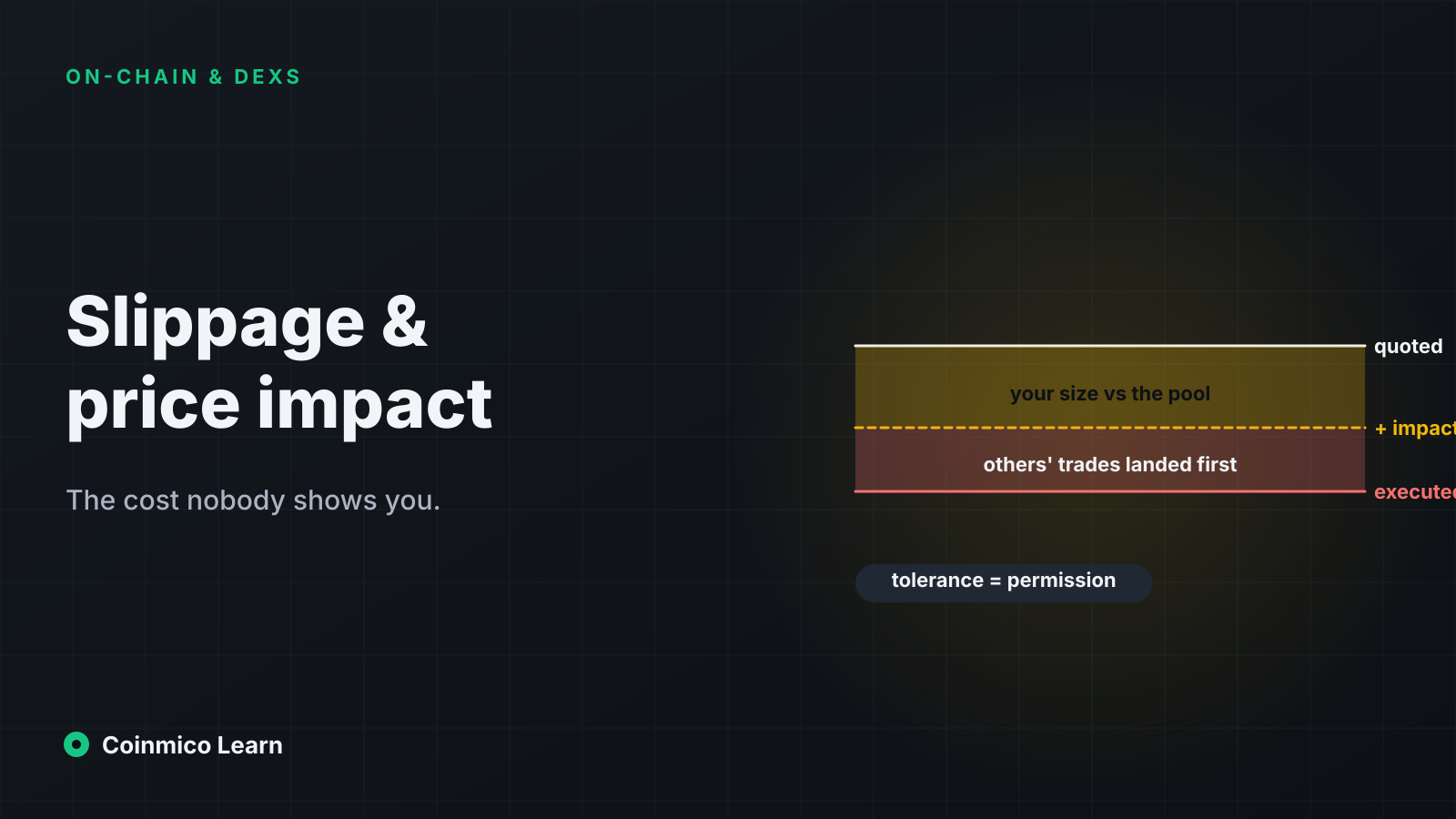
- Price impact is the cost of your own trade moving the pool. It is known before you sign and depends only on your size versus the pool's depth.
- Slippage is the difference between the quoted price and the executed price, caused by other trades landing before yours. It is unknown until execution.
- Your slippage tolerance is the worst price you will accept. Set it loose and sandwich bots will take exactly that much.
A swap interface shows you a price, you sign, and the tokens arrive — fewer than you expected. The interface will call the difference "slippage". Usually it is two different costs, only one of which you could have avoided.
Price impact
Price impact is the cost of your own trade against the pool. The AMM lesson showed that a swap moves the pool along its curve, so the average price you pay is worse than the price before you traded. This is fully determined by two numbers — your trade size and the pool's depth — and it is known before you sign. Good interfaces display it.
The relationship is roughly:
| Your trade as a share of the pool's reserve | Approximate price impact |
|---|---|
| 0.1% | 0.2% |
| 1% | 2% |
| 5% | 10% |
| 10% | 22% |
| 25% | 67% |
Impact is not a fee and does not go to anyone directly; it is the shape of the curve. Arbitrage bots capture it afterwards, buying the token back from the pool at the price you pushed it to.
How to reduce it: trade a smaller size, use a deeper pool, or let the router split the trade across several pools. Splitting a large order into pieces over time helps only if arbitrage restores the pool between pieces — which on a busy pool it does within a block or two.
Slippage
Slippage proper is the difference between the price you were quoted and the price you actually got, caused by other transactions landing before yours. Between the quote and the block that includes your swap, other people trade the same pool. If they pushed the price the wrong way, you get less.
Unlike impact, slippage is unknown until execution. It is small on quiet pools and large on pools that are being traded hard — a new token during its launch minutes, or any pool during a market-wide move.
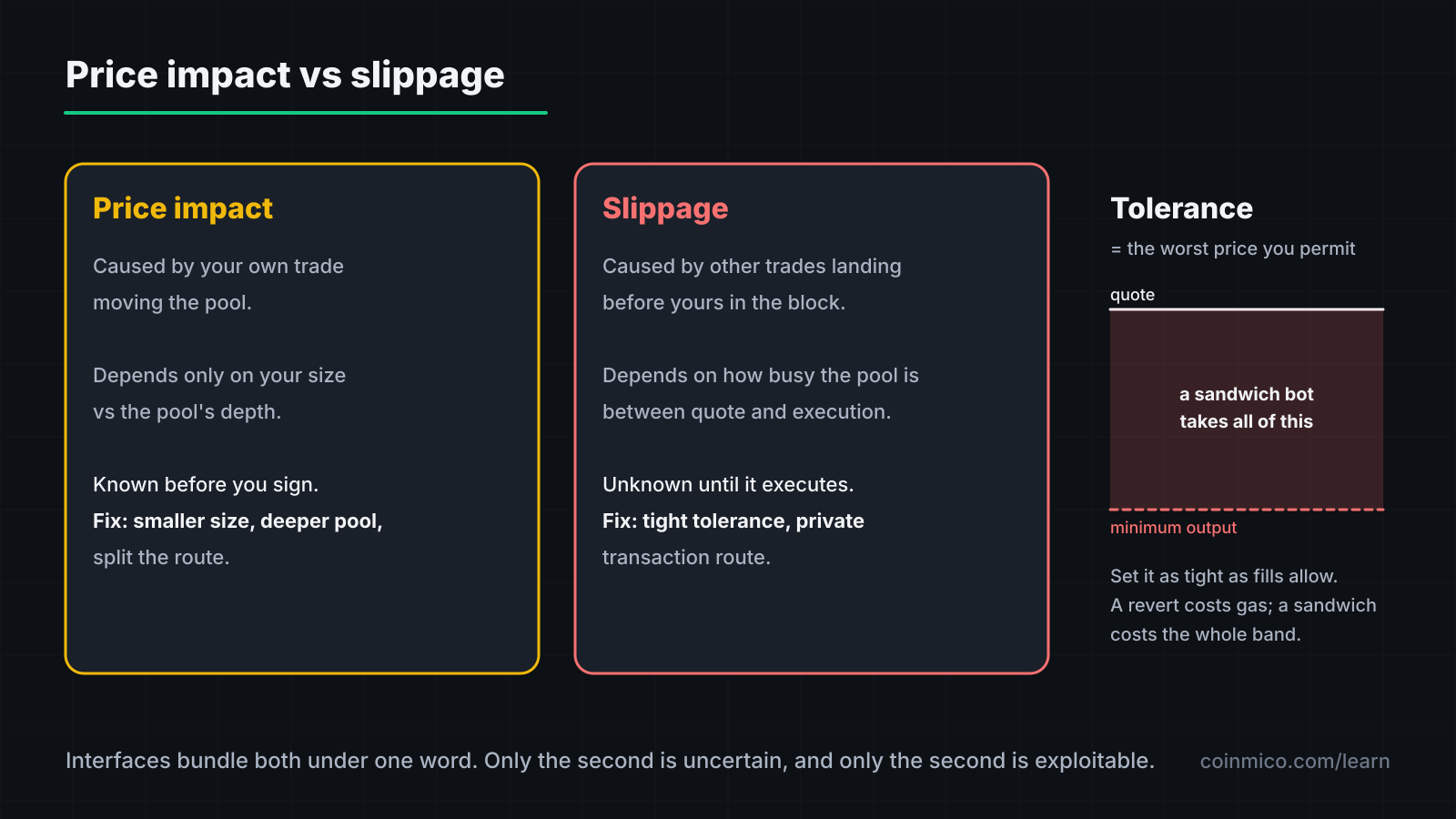
The tolerance setting
Because slippage cannot be known in advance, every swap carries a minimum output: the fewest tokens you will accept. The interface derives it from your slippage tolerance — a percentage below the quote. If the executed price would deliver less than the minimum, the transaction reverts: no swap happens, and you pay only the gas.
| Tolerance | Effect |
|---|---|
| 0.1% | Fills only if the pool barely moved. Frequently reverts on active pools; safe. |
| 0.5% | The common default. Fine for deep pools. |
| 1–3% | Needed for volatile or thin pools. Exposed to bots. |
| 5–50% | Used to force a fill on a launching token. You are announcing the worst price you will take, and someone will make sure you take it. |
The key point: tolerance is not a prediction. It is a permission. You are permitting anyone who can order transactions to give you a price that bad.
Sandwich attacks
That permission is exploited by MEV bots — programs that watch pending transactions and pay block producers to order them profitably.
A sandwich works like this:
- The bot sees your pending swap: buy token X, tolerance 3%.
- It places its own buy of X immediately before yours, pushing the pool's price up.
- Your swap executes at the worse price — up to 3% worse, right at your minimum.
- The bot sells X immediately after yours, into the price your trade pushed up further.
The bot pockets almost exactly the slack you allowed. Your transaction did not fail, so nothing looks wrong; you simply received 3% less than the quote. On Ethereum this is done thousands of times a day; on Solana and the L2s it is done with lower fees and more often.
Defences:
- Set tolerance to the smallest value that will fill. A revert costs gas; a sandwich costs the whole tolerance.
- Use a private transaction route (an RPC that does not broadcast to the public mempool) when the interface offers one.
- Split a large trade into pieces so each has small impact and therefore small slack to capture.
- On a launching token with wild swings, accept that a wide tolerance is a fee you are choosing to pay, and size accordingly.
Reading a swap quote
Before signing, a quote should tell you four things:
- Rate — the pool's price before your trade.
- Price impact — what your size does to it. Above 1% on a normal trade means the pool is too shallow for your size.
- Minimum received — the rate minus impact minus tolerance. This is the number you are actually agreeing to.
- Route — which pools the trade passes through. A three-hop route through an obscure intermediate token has three pools' worth of impact and three chances to be sandwiched.
If the interface does not show impact separately from slippage, compute it: quote the same trade at one-tenth the size. The difference in rate is your impact.
How this shows up in measured data
Coinmico indexes every swap on the chains and venues it covers, so the price it records for a DEX pair is the actual executed rate, trade by trade — impact and slippage included. A thin pool shows up as a wide spread between consecutive prints and a large gap from the coin's index price. When a coin's page shows its on-chain price diverging from its centralised-exchange price, this is usually why: the pool is shallow enough that every trade moves it visibly.
 EthereumETHAcross 50 spot markets we index
What this means in practice
- Impact is your size against the pool. See it before you sign, and trade smaller or deeper if it exceeds 1%.
- Tolerance is what you permit bots to take. Set it as tight as fills allow.
- A quote is a set of promises. Read the minimum received, not the rate.
Next in this track
New tokens are where impact, slippage and outright fraud meet. The final lesson in this track shows how to read a pool that was created an hour ago and decide whether it is a market or a trap.
Assets in this piece
 Ethereum
 Solana
Every figure here is measured by Coinmico across the venues and chains we index. See our methodology.