Reading a new token: pools, holders and the rug-pull checklist
Thousands of tokens launch every day and most are worthless within a week. The information to tell a market from a trap is public and on chain. This lesson shows what to read, in what order, and what each red flag looks like in the data.
What you will learn
- A new token's price is set by one pool, and the pool is usually controlled by the deployer. Liquidity that can be withdrawn is not liquidity.
- Check, in order, who holds the supply, whether the pool's liquidity is locked or burned, whether the contract can mint or block selling, and whether the volume is one address talking to itself.
- Coinmico admits a new coin to its listings only after it has traded for a full day with real turnover on more than one market, which filters out most of what this lesson describes.
Anyone can create a token in minutes and a pool for it in one more. The result is a market with a price, a chart and a volume figure, all of which mean nothing until you know who controls the pool. This lesson is a reading order for a token you have never heard of.
Start with the pool, not the price
A new token typically trades in a single pool against the chain's coin or a stablecoin. Everything about its price comes from that pool, so read it first.
Liquidity. How many dollars are on each side? A token with a 10-million-dollar "market cap" and 20,000 dollars of pool liquidity cannot be sold in any size — the AMM lesson showed why. Market cap on a new token is a projection; liquidity is the only real number.
Who provided it. Usually the deployer. That is normal. The question is whether they can take it back.
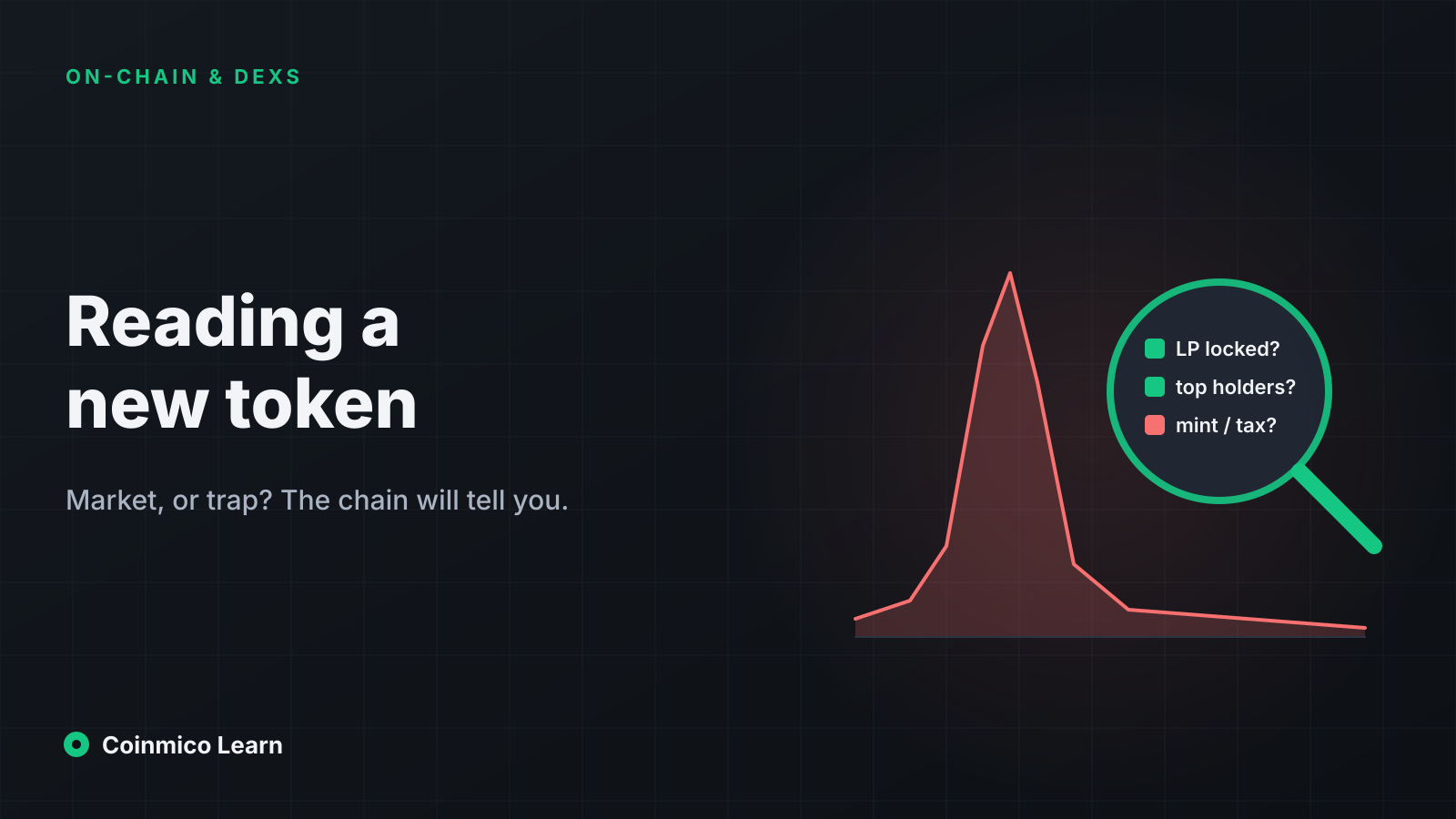
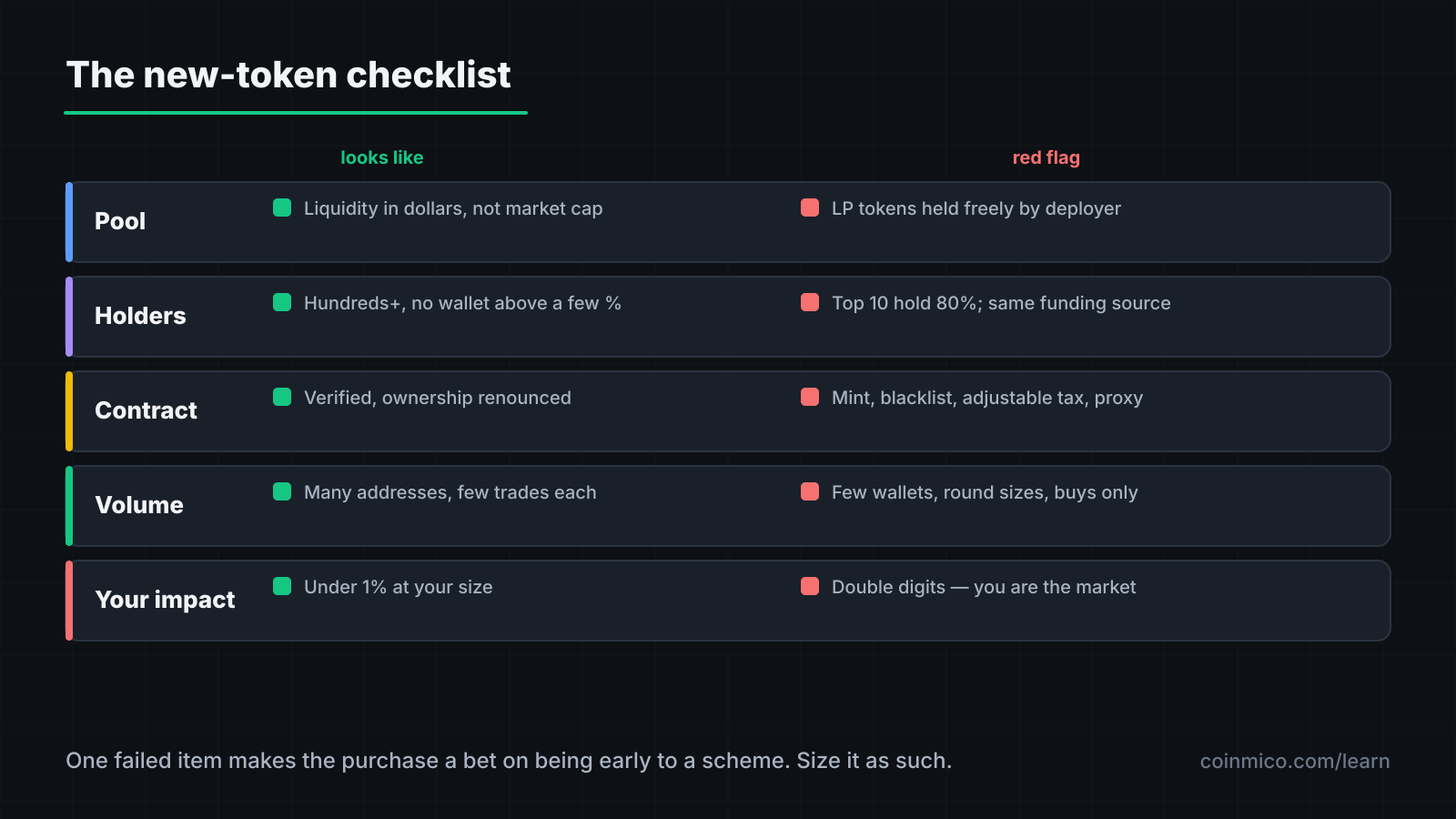
Is it locked or burned? LP tokens represent ownership of the pool's reserves. If the deployer holds them freely, they can withdraw both sides of the pool at any moment — the rug pull. Legitimate launches lock LP tokens in a time-lock contract for months or burn them (send them to an unrecoverable address), and say so verifiably. "Liquidity locked" claimed in a chat message is nothing; a lock contract address you can inspect is something.
Holder distribution
Every balance is public. Look at the top holders.
- Deployer and team share. Above 20–30% of supply in wallets connected to the deployer means they can dump into the pool at will. Some projects disclose team allocations with vesting; undisclosed large holdings are the flag.
- Top 10 concentration. If ten addresses hold 80% of the supply, the "market" is those ten people. Watch for many wallets funded from the same source at the same time — one owner split across addresses to look distributed.
- Pool share. The pool itself is often the largest holder. That is fine; it is the liquidity.
A healthy distribution a week after launch has hundreds or thousands of holders, no single non-pool address above a few percent, and a deployer allocation that is disclosed and vesting.
Contract permissions
The token is a program, and the program may include functions its owner can call. The dangerous ones:
| Permission | What it allows | Flag |
|---|---|---|
| Mint | Owner can create new tokens at will | Unlimited dilution; the owner can print and sell |
| Blacklist / pause | Owner can block addresses from transferring | Can stop you selling while they exit |
| Adjustable fees | Owner can set a transfer tax | Tax raised to 99% is a **honeypot**: you can buy but never sell |
| Proxy / upgradeable | Owner can replace the code | Any of the above can be added later |
| Ownership not renounced | Owner still exists | All of the above remain possible |
Tools that scan a contract for these functions are widely available and take seconds. A contract that is verified (source code published), has ownership renounced and has no mint or blacklist function has removed the mechanical ways to defraud you. It has not removed the deployer's ability to sell their own holdings.
The volume pattern
New tokens routinely show impressive volume that is one address trading with itself. The volume lesson covered wash trading on centralised exchanges; on chain it is easier to spot because every trade has a sender.
- Few unique traders, many trades. Real interest is many addresses making a few trades each.
- Round, repeated sizes. Bots wash-trading tend to use fixed amounts on a schedule.
- Volume with no holder growth. Turnover rising while the holder count is flat means the same wallets are cycling.
- Buys only. Early charts that go straight up on buys with almost no sells are often the deployer's wallets bidding it up before selling into the buyers they attract.
The launch-hour pattern
The first hours of a new pool follow a script often enough that it is worth knowing:
- Pool created with modest liquidity. Deployer wallets buy in the first block, before anyone else can — a snipe.
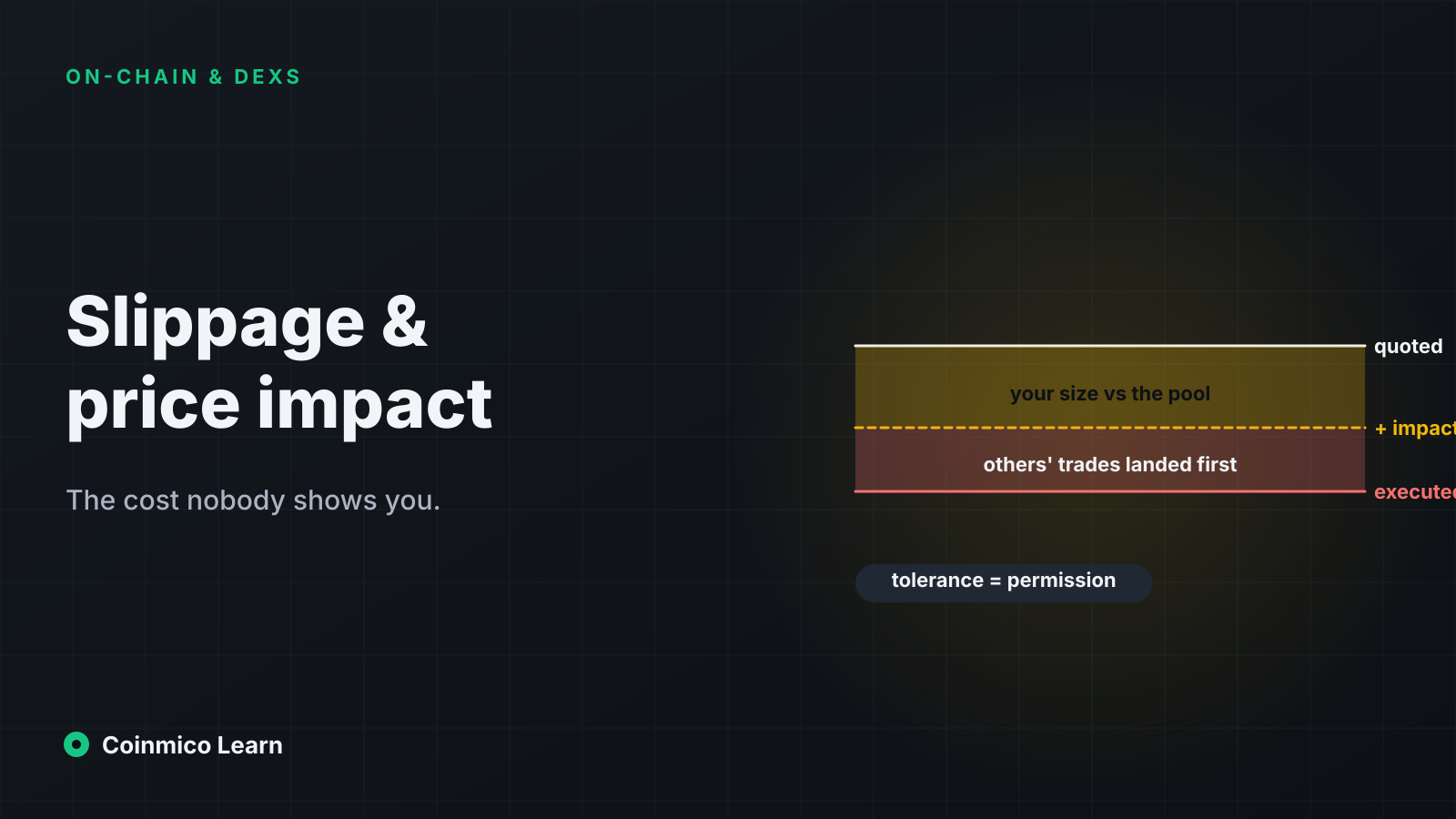
- Promotion begins. Price rises 5–50× on small liquidity as buyers arrive; every buy has enormous price impact.
- Deployer and snipers sell into the buyers. Price collapses 80–95%. Or the deployer withdraws liquidity outright.
- The chart shows a vertical spike and a flat line at zero. Total elapsed time: minutes to hours.
A token that survives its first day with liquidity intact, a growing holder count and a deployer who has not sold is not thereby good — but it has passed the test that most fail.
What Coinmico's listings do
Coinmico's new coins page is built to exclude exactly this. Before an asset appears, it must have been observed for at least a full day, with at least 250,000 dollars of measured 24-hour turnover across at least two markets — or one market with turnover no single wallet can cheaply fake — and a reference price the index trusts. The methodology states each threshold. Tokens that launch and die within hours never qualify, and the page publishes at most a handful of admissions a day so that a listing is a filtered event rather than a firehose.
| Coin | Market | First print | Now | Since |
|---|---|---|---|---|
 GnosisGNO GnosisGNO | Korbit · GNOKRW | $112.62 | $114.73 | 1.87% |
 SperaxSPA SperaxSPA | Coinone · SPAKRW | $0.003667 | $0.003655 | 0.32% |
 HyperliquidHYPE HyperliquidHYPE | Binance · HYPEUSDT | $91.84 | $93.81 | 2.14% |
 NexpaceNXPC NexpaceNXPC | Upbit · NXPCBTC | $0.5782 | $0.2547 | 55.95% |
 musebookMUSEBOOK musebookMUSEBOOK | BingX · MUSEBOOK-USDT | $0.000196 | $0.000204 | 3.69% |
 ArciumARX ArciumARX | Upbit · ARXBTC | $0.2337 | $0.2532 | 8.36% |
 LitecoinLTC LitecoinLTC | BitMart · LTC_BTC | $64.19 | $71.09 | 10.74% |
 GoldfinchGFI GoldfinchGFI | Gate.io · GFI_ETH | $0.0447 | $0.0515 | 15.30% |
That filter is a floor, not an endorsement. A token that clears it can still fall 90%. It has merely shown it is a market.
The checklist
Before buying a token you learned about today:
- Pool liquidity in dollars, and whether LP tokens are locked or burned — with the lock contract, not a promise.
- Top-holder share, and whether the top wallets share a funding source.
- Contract: verified, ownership renounced, no mint or blacklist, no adjustable tax, not upgradeable.
- Unique traders versus trade count; holder growth versus volume.
- Your own price impact at the size you intend.
If any item fails, the honest name for the purchase is a bet on being early to a scheme, and it should be sized as such.
Where to go from here
You have finished the On-chain & DEXs track. Everything in it depends on a wallet signing transactions — and signing is where most on-chain losses actually happen. The Security track begins with the seed phrase and ends with the approval prompt.
Assets in this piece
 Ethereum
 BNB
BNB Solana
Every figure here is measured by Coinmico across the venues and chains we index. See our methodology.