Coins vs tokens: what the difference means for you
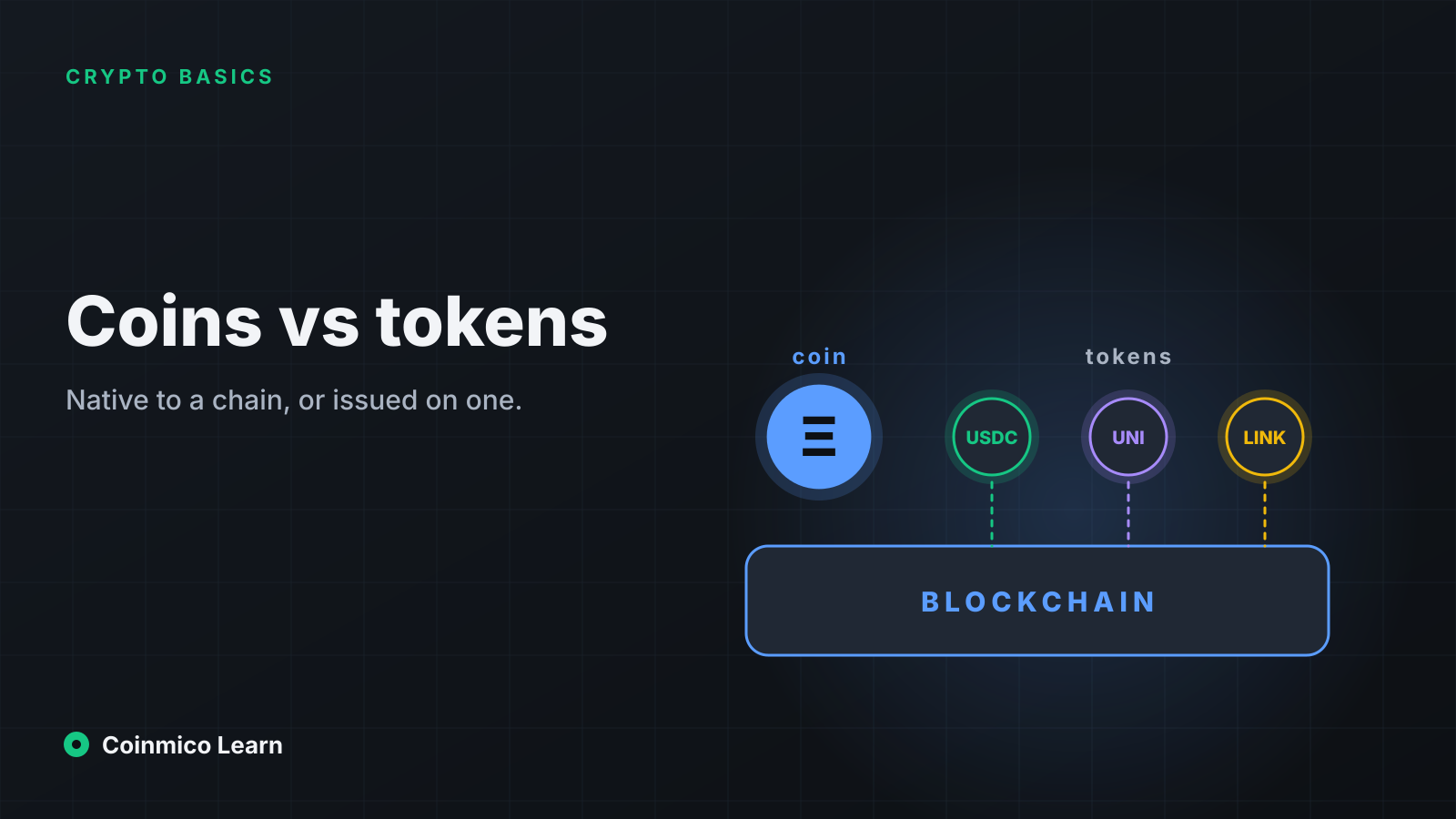
A coin runs its own network. A token is a program on someone else's. That one difference explains fees, bridges, stablecoins and why the same asset can trade at slightly different prices on different chains.
What you will learn
- A coin pays for the network it lives on; a token pays fees in someone else's coin.
- The same token can exist on many chains, and each copy is a separate contract with its own liquidity.
- Coinmico tracks one asset across all its chain deployments and venues, so a token's page shows the whole market rather than one contract.
Every asset on Coinmico is either a coin or a token, and the label changes how you should read its numbers. This lesson explains the difference and the consequences that follow from it.
The one-sentence version
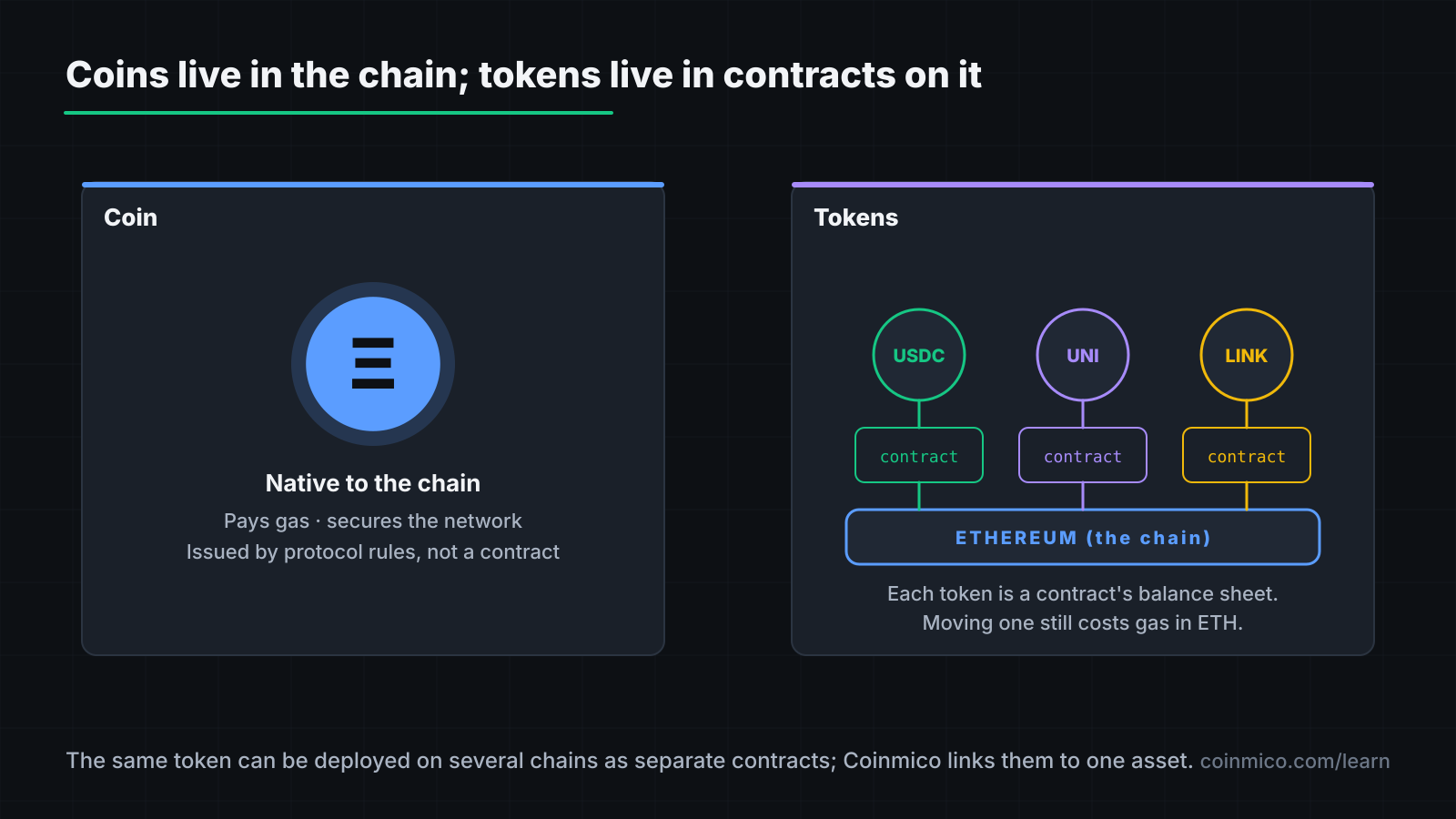
A coin is the native unit of its own blockchain. A token is created by a program — a smart contract — running on an existing blockchain.
Ether (ETH) is the coin of the Ethereum network. USDC on Ethereum is a token: a contract on Ethereum that keeps a list of balances and lets people move them. USDC does not have a blockchain of its own; it borrows Ethereum's.
Why the distinction matters
Fees are paid in the coin
Everything that happens on a blockchain costs a fee, and the fee is paid in that chain's coin. Sending USDC on Ethereum costs a little ETH. Sending USDC on Solana costs a little SOL. This catches newcomers out: you can hold a wallet full of tokens and be unable to move them because you have none of the underlying coin.
A coin's demand is tied to its network
Because every transaction on a chain consumes its coin, the coin's demand is partly a bet on how busy the chain will be. Tokens have no such link — a token's value depends on whatever the contract represents (a dollar, a share of a protocol's fees, a place in a game), not on the chain it happens to live on.
Tokens can be frozen; coins usually cannot
A token is a program, and programs can include an owner with special powers. Most stablecoins can freeze an address on request from law enforcement. Some tokens can be minted without limit by their deployer. A native coin's rules are the network's rules and have no owner. This is not a reason to avoid tokens — a frozen stablecoin balance is rare — but it is something you are trusting.
One token, many chains
A token issuer can deploy the same contract on several chains. USDT exists on Ethereum, Tron, Solana, BNB Chain and a dozen others. Each deployment is a separate contract with its own supply, its own liquidity and its own set of trading pairs.
For the issuer this is one dollar-backed token. For the market it is many pools of liquidity that arbitrage traders keep roughly in line. When they fall out of line — usually during network congestion or a bridge incident — the same token can briefly trade at different prices on different chains.
Coinmico treats an asset as a single thing and gathers every deployment and every exchange listing underneath it. USDT's page, for example, combines its centralised-exchange pairs with its on-chain pools across every chain we index:
 TetherUSDTAcross 25 spot markets we index
The "markets" count in that block is the number of places we measure the price. A high count is a sign the asset is deeply traded; a count of one or two means the price rests on a thin market and should be read with care.
Wrapped and bridged versions
A special kind of token represents a coin from another chain. Wrapped bitcoin (WBTC) is an Ethereum token backed by real BTC held in custody. Bridged ETH on an L2 is a token on that L2 backed by ETH locked on Ethereum.
These are useful — they let bitcoin be used in Ethereum applications — but they add a layer of trust: the custodian or bridge must actually hold the backing. Coinmico lists wrapped and bridged assets separately from the original and excludes them from market-wide totals so the same value is not counted twice. The methodology lists the rules.
Stablecoins are tokens too
A stablecoin is a token designed to hold a fixed price, usually one US dollar. The two largest, USDT and USDC, hold reserves of cash and short-term government debt and allow large holders to redeem tokens for dollars. That redemption promise is what keeps the price near $1.00 — if it drifts to $0.99, someone buys it and redeems it for $1.00.
Stablecoins are the plumbing of crypto trading: most trading pairs on exchanges are quoted in them, and they dominate on-chain volume. The compare block below shows how their supply — the number of tokens in existence — has moved recently, a rough gauge of how much money is parked in the system:
How this shows up in the data
| What you see | Coin | Token |
|---|---|---|
| Pays its own transaction fees | Yes | No — needs the chain's coin |
| Lives on several chains | Rarely | Often |
| Can be frozen by an issuer | Almost never | Frequently possible |
| Supply set by | Network rules | The contract and its owner |
| Counted in Coinmico global totals | Yes | Yes, except wrapped and bridged copies |
Next in this track
Whether you hold a coin or a token, it sits at an address, and whoever holds the key to that address controls it. The next lesson explains what a wallet actually is — and what it is not.
Assets in this piece
 Ethereum
 Tether
 USDC
USDC Solana
Every figure here is measured by Coinmico across the venues and chains we index. See our methodology.