How a crypto exchange works — and where the price comes from
A price is not announced; it is discovered, one trade at a time, on dozens of venues at once. This lesson opens up an order book, follows a trade through it, and shows how Coinmico turns thousands of those trades into the number on a coin page.
What you will learn
- An exchange matches buyers and sellers in an order book; the price is simply the last match.
- Every exchange has its own book and its own price. They stay close because arbitrage traders profit from the gaps.
- Coinmico measures trades on each venue directly and combines them with volume weighting, so one venue cannot set the price alone.
If you have ever wondered why bitcoin is 87,412 on one site and 87,398 on another, the answer is that there is no single bitcoin price. There are hundreds — one per trading pair on every exchange — and each site chooses how to summarise them. This lesson explains where those prices come from and how Coinmico builds its summary.
The order book
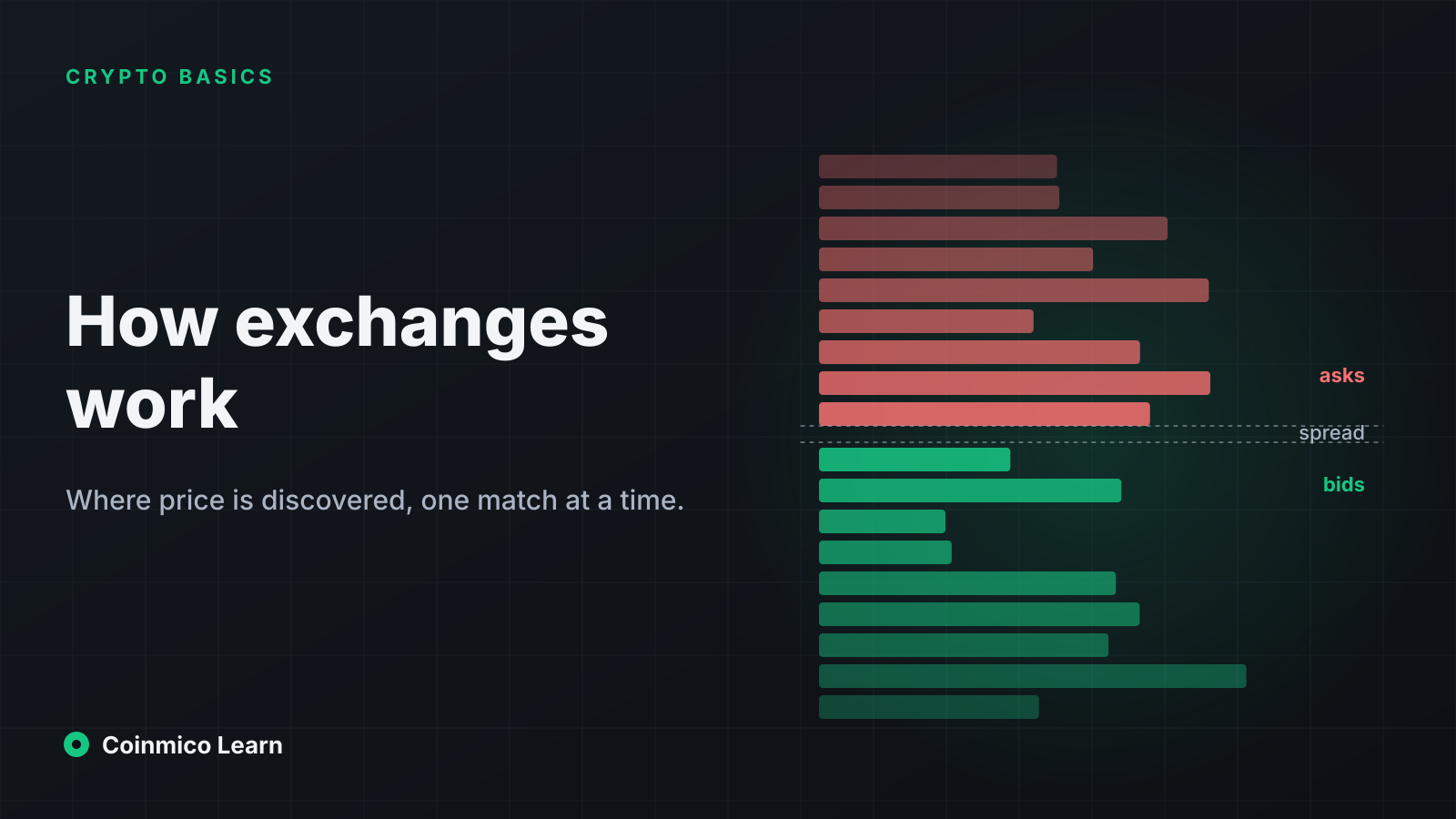
A centralised exchange (CEX) is a marketplace with a matching engine at its centre. Traders send in orders — buy 0.5 BTC at 87,400 or better, sell 2 BTC at 87,450 or better — and the engine keeps them in a list called the order book.
- Bids are buy orders, stacked from the highest price down.
- Asks are sell orders, stacked from the lowest price up.
- The gap between the best bid and the best ask is the spread.
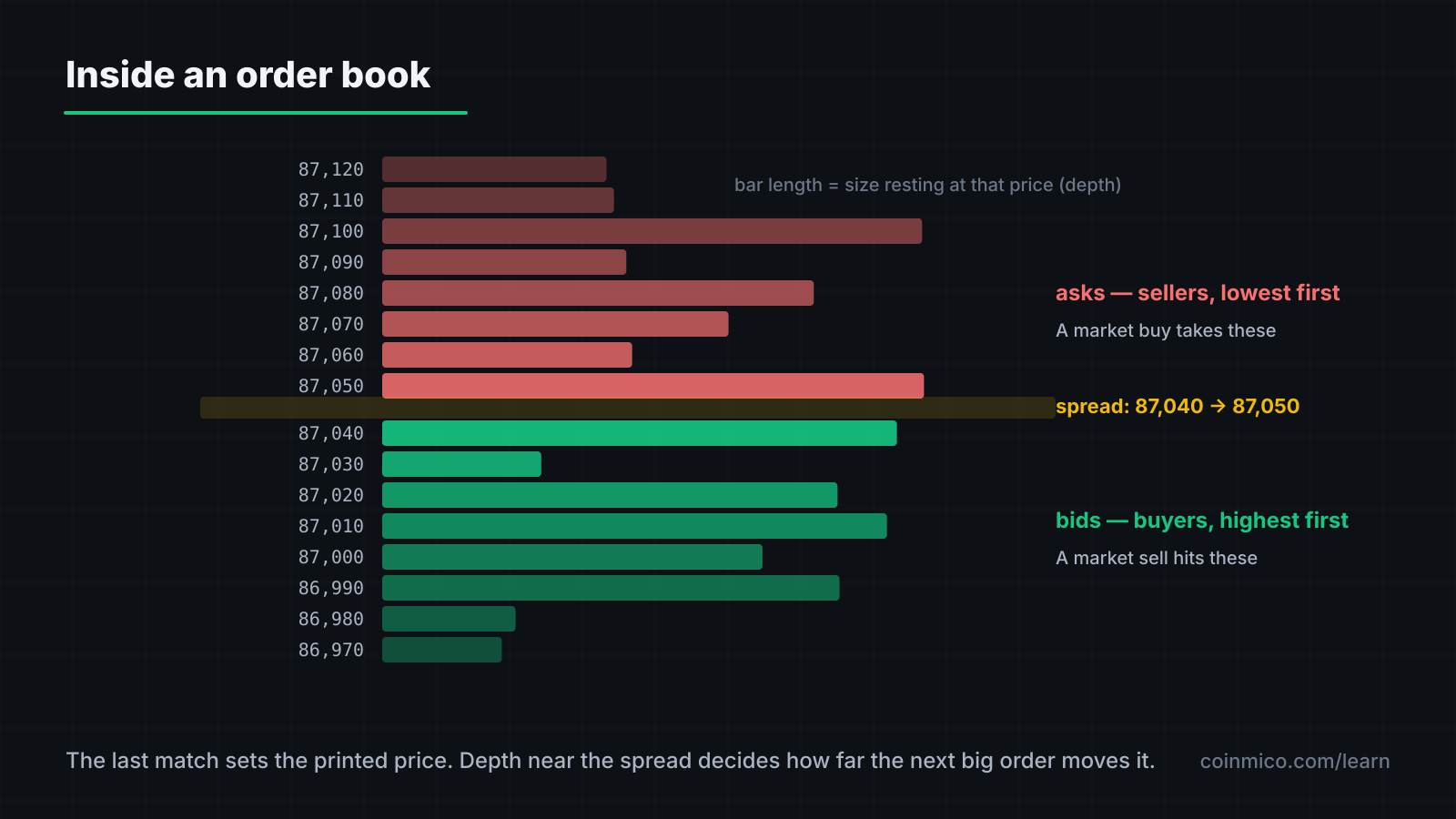
When someone submits an order that crosses the spread — a buy at or above the best ask — the engine matches it against resting orders and a trade happens. The price of that trade becomes the "last price" you see on the ticker. That is all a price is: the most recent match.
Why every exchange shows a different number
Each exchange runs its own book, with its own traders, fees and deposit rails. Binance's BTC/USDT book and Coinbase's BTC/USD book are separate markets that happen to trade the same thing. Their prices differ by a few dollars at any moment, for mundane reasons:
- Different quote currencies (USDT is not exactly a dollar, and neither is USDC).
- Different local demand — Korean exchanges trade in won and have at times run at a persistent premium.
- Different fee structures that shift where large traders prefer to execute.
The gaps stay small because of arbitrage: if bitcoin is cheaper on venue A than venue B, a trader buys on A and sells on B until the gap closes. This happens continuously, in milliseconds, and it is the reason a "bitcoin price" is a meaningful idea at all.
Spot, derivatives and DEXs
The order book above is a spot market: you pay the quote currency and receive the coin. Two other kinds of venue matter:
- Derivatives exchanges trade contracts whose value tracks the coin without delivering it. The largest by volume are perpetual futures, covered in the trading track.
- Decentralised exchanges (DEXs) have no order book at all. Traders swap against a pool of tokens governed by a formula. The on-chain track explains how.
Coinmico ranks all three kinds by the volume we measure on them: spot exchanges, derivatives venues and DEXs.
From thousands of trades to one price
Coinmico connects to each exchange's live trade feed and records every trade as it prints. For a coin like bitcoin that is tens of thousands of trades an hour across dozens of pairs. Turning that into a single price takes three steps:
- Convert every trade to US dollars. A trade in USDT, EUR, KRW or IDR is converted at the rate for that quote currency at that moment, so a Korean-won pair and a dollar pair can be compared.
- Weight each venue by its recent volume. A venue that traded 10 million dollars in the last window counts more than one that traded ten thousand. A tiny venue with a stale or manipulated price therefore barely moves the figure.
- Reject outliers. A pair printing far from the rest is treated as broken and left out until it returns to line.
The result is the index price on every coin page, updating as trades arrive:
 BitcoinBTCAcross 50 spot markets we index
The methodology page documents the exact window, weights and outlier rules. The important part for a reader is what the number is not: it is not one exchange's ticker, and it is not a figure copied from another data site.
Volume: what the exchange reports vs what we count
Exchanges publish their own 24-hour volume, and some have historically inflated it. Coinmico does not use those figures. The volume on an exchange page is the sum of the trades we recorded on that exchange's feed, converted to dollars — a number we can stand behind because we watched every trade in it. The lesson on volume goes into what that difference reveals.
| Coin | Price | 24h | 24h volume | Market cap |
|---|---|---|---|---|
| BitcoinBTC | $84,180.23 | 2.68% | $20.91B | $1.69T |
 EthereumETH EthereumETH | $2,666.76 | 3.15% | $9.35B | $325.5B |
 USDCUSDC USDCUSDC | $1.00 | 0.00% | $5.58B | $75.14B |
 XRPXRP XRPXRP | $1.50 | 4.54% | $3.91B | $94.61B |
 SolanaSOL SolanaSOL | $114.48 | 3.03% | $2.62B | $67.27B |
 ZcashZEC ZcashZEC | $1,526.90 | 2.18% | $1.80B | $25.87B |
 NEAR ProtocolNEAR NEAR ProtocolNEAR | $4.36 | 2.22% | $1.47B | $5.69B |
 TetherUSDT TetherUSDT | $0.9999 | 0.02% | $1.19B | $183.5B |
 DogecoinDOGE DogecoinDOGE | $0.0926 | 7.41% | $1.13B | $14.45B |
 UniswapUNI UniswapUNI | $9.21 | 0.03% | $1.05B | $5.72B |
What this means in practice
- A coin's price is a summary. If it matters to you exactly, look at the venue you will actually trade on.
- Wide spreads and few venues mean the price is fragile; check the markets count on the coin page before relying on it.
- Volume that only one exchange reports is a claim. Volume measured from the trade feed is a record.
Where to go from here
You have finished the Crypto basics track. The Reading market data track picks up from here and teaches you how to read market cap, volume, dominance and sentiment without being misled by any of them.
Assets in this piece
 Bitcoin
Every figure here is measured by Coinmico across the venues and chains we index. See our methodology.