Wallets, keys and addresses: what you actually hold
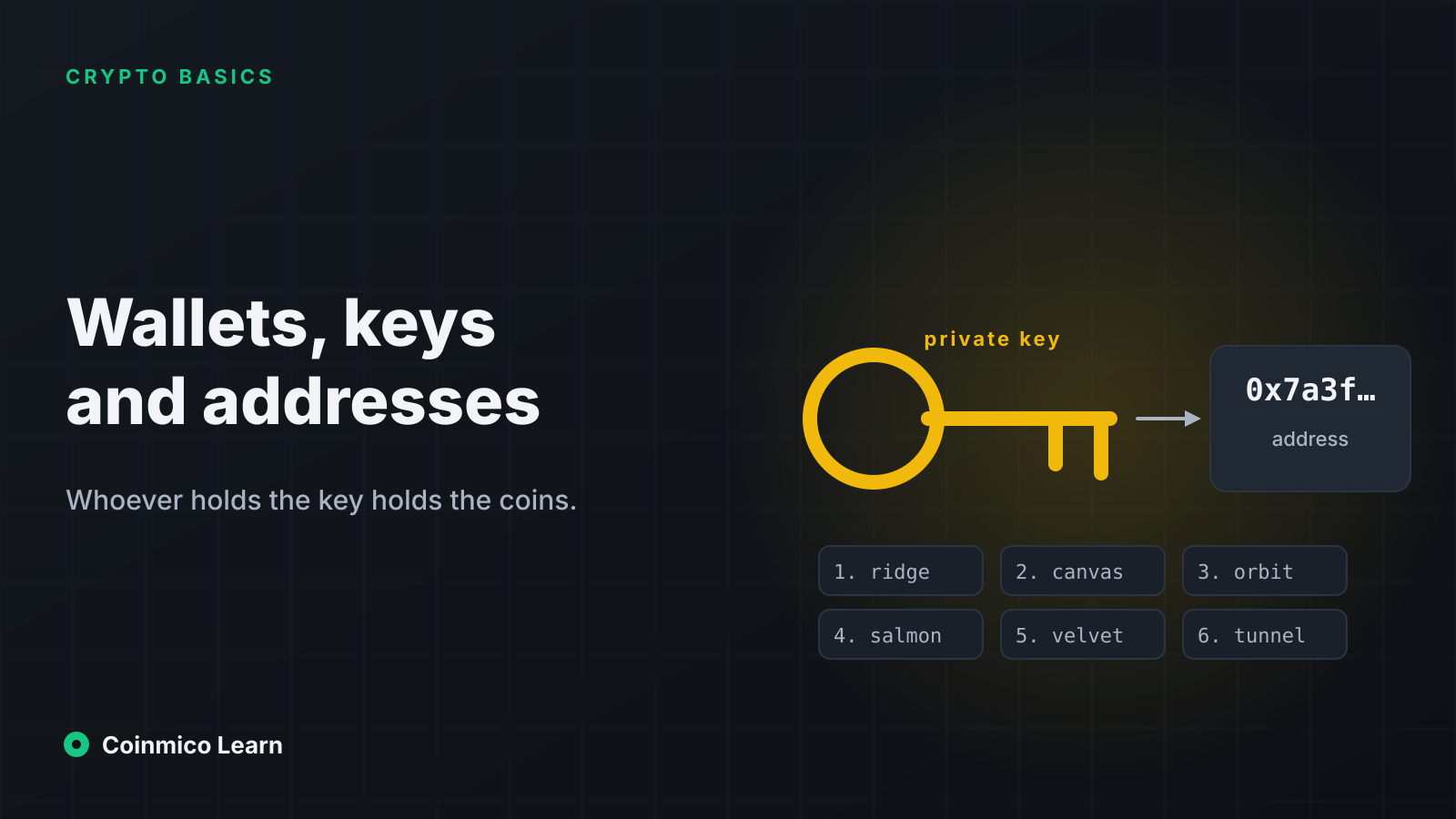
A wallet holds no coins. It holds a key, and the key controls an entry on the ledger. Once that clicks, seed phrases, hardware wallets and "not your keys, not your coins" all make sense.
What you will learn
- Coins live on the ledger, not in the wallet. The wallet holds the private key that can move them.
- An address is derived from the key one way; you can share it freely, but the key must never leave your control.
- A seed phrase regenerates every key in the wallet, which is why it is the only backup that matters.
The word "wallet" is the most misleading term in crypto. A physical wallet holds cash. A crypto wallet holds nothing of the sort — the coins never leave the ledger. What the wallet holds is a key, and the key is what gives you the power to move the coins.
Three things that get confused
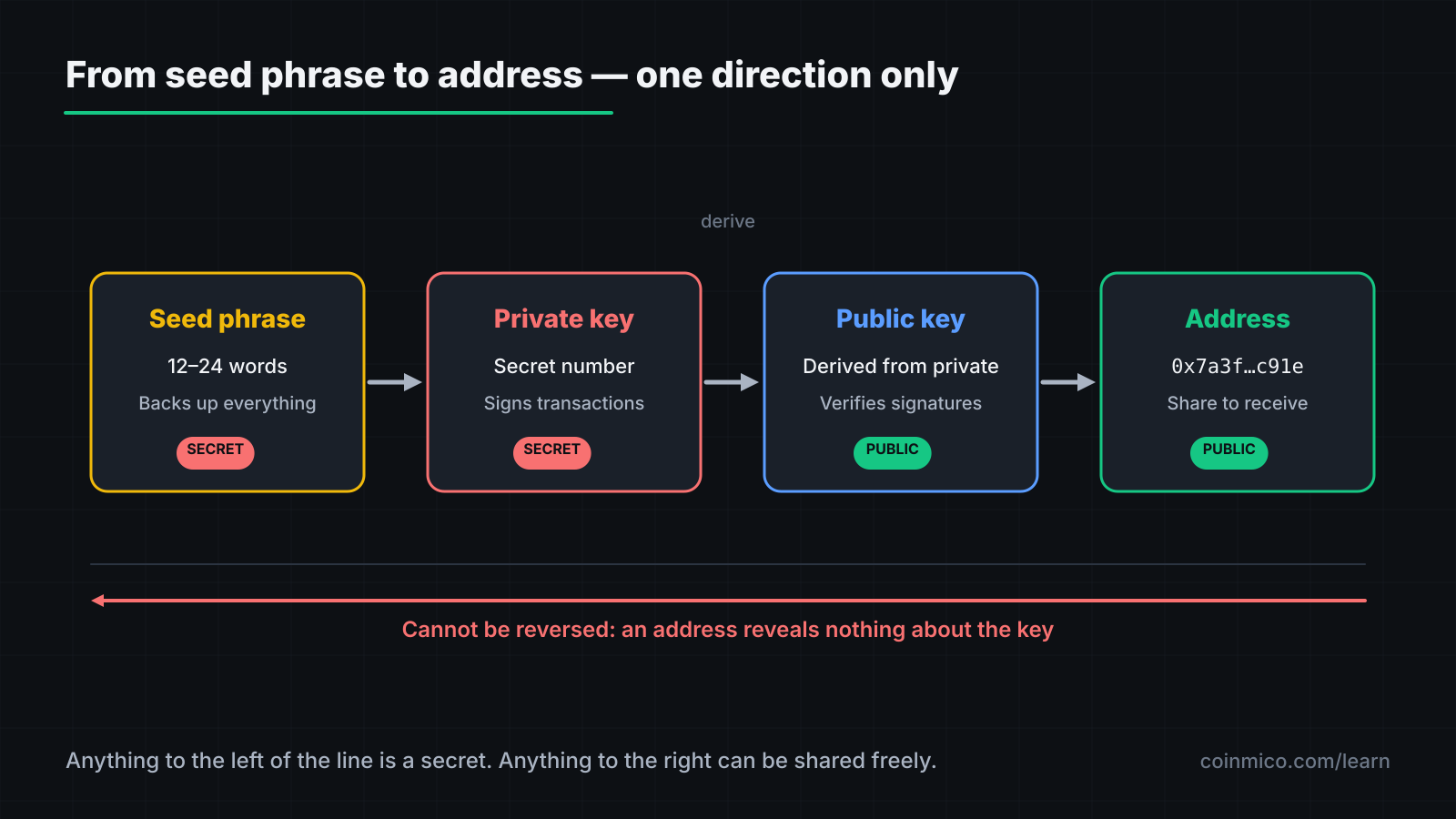
Private key. A very large random number. Whoever knows it can sign transactions that move the coins at the matching address. It must stay secret.
Public key and address. Mathematically derived from the private key in one direction only: the key produces the address, but the address cannot be reversed into the key. The address is what you give people so they can pay you. It is safe to share.
Seed phrase. Twelve or twenty-four ordinary words that encode a master secret. From that secret a wallet derives every private key it will ever use, on every chain. Anyone with the phrase has every key.
What happens when you "send" coins
- Your wallet builds a message: move 0.1 BTC from address A to address B.
- It signs the message with the private key for A. The signature proves the sender holds the key without revealing it.
- The signed message is broadcast to the network. Every node checks the signature against address A and, if it is valid, includes the transaction in a block.
- The ledger now shows 0.1 BTC less at A and 0.1 BTC more at B.
Nothing moved between two devices. Two numbers changed on a ledger that everyone holds. Your wallet app simply reads the ledger and shows you the balance at your addresses.
Kinds of wallet
The categories describe where the private key lives, and therefore what could go wrong.
| Type | Where the key is | Main risk |
|---|---|---|
| Exchange account | On the exchange's servers | The exchange fails, freezes withdrawals or is hacked |
| Software (hot) wallet | On your phone or computer | Malware, phishing, a malicious signature request |
| Hardware (cold) wallet | On a dedicated device that never exposes the key | Losing the device *and* the seed phrase |
| Paper or metal backup | Written down, offline | Fire, loss, someone reading it |
An exchange account is not a wallet in the strict sense at all. The exchange holds the keys and owes you a balance, much as a bank does. That is convenient and often sensible for active trading. It also means that if the exchange stops honouring withdrawals, your balance is a claim against a company rather than coins you control. The custody lesson weighs the trade-off.
Why the seed phrase is the only backup
Because every key is derived from the seed, backing up the phrase backs up the entire wallet — including addresses you have not used yet. Lose the phone and the phrase restores everything on a new one. Lose the phrase and the phone and the coins are unreachable forever. There is no "forgot password" link; no company can reset it, because no company has it.
The flip side: anyone who sees the phrase can drain the wallet from anywhere in the world, silently. Every serious theft from an individual comes down to one of two things — the phrase was exposed, or the owner signed something they should not have. The security track covers both in depth.
Addresses look different on every chain
Bitcoin addresses begin with 1, 3 or bc1. Ethereum and every EVM chain use the same 0x… forty-hex-character format. Solana uses a longer base-58 string. Sending coins to an address on the wrong chain — ETH to a Bitcoin address, or a token on BNB Chain to an Ethereum-only exchange deposit address — usually loses them. Wallets and exchanges now block most of these mistakes, but the check is still yours to make.
Reading a wallet on Coinmico
Because balances are public, anyone can look up an address and see what it holds and how it has traded. Coinmico's wallet tracker values an address's holdings at the prices we measure, and the whale tracker ranks the addresses whose on-chain trades we have followed. Note what this shows and what it does not: the address's activity is fully visible, but who controls it is not — an address is a key, not an identity.
What this means in practice
- Treat the seed phrase as the asset. Store it offline, in more than one place, and never type it into a website.
- Keep only what you are actively trading on an exchange; move the rest to a wallet whose key you hold.
- Check the chain before you send, every time.
Next in this track
Coins move between addresses, but the price is set where they change hands — on exchanges. The final lesson in this track explains what happens inside one, and how Coinmico turns thousands of trades into a single price.
Assets in this piece
 Bitcoin
 Ethereum
Every figure here is measured by Coinmico across the venues and chains we index. See our methodology.