What a cryptocurrency actually is
Strip away the jargon and a cryptocurrency is three things working together — a shared ledger, a set of rules for changing it, and a unit that the rules count. This lesson walks through each one.
What you will learn
- A blockchain is a ledger that thousands of computers keep identical copies of, so no single party can quietly edit it.
- A coin is the unit the ledger counts; its price is simply what people last paid for it on exchanges.
- "Decentralised" is a spectrum. The useful question is who could change the rules, and how many of them would have to agree.
Most explanations of cryptocurrency start with the price. That is backwards. The price is the last thing that happens, after a great deal of machinery has done its job. Start with the machinery and the price makes more sense.
A ledger everyone holds a copy of
A ledger is just a list of who owns what. Your bank keeps one for your account; a company keeps one for its shareholders. In both cases a single organisation holds the book and you trust it not to make mistakes or edit history.
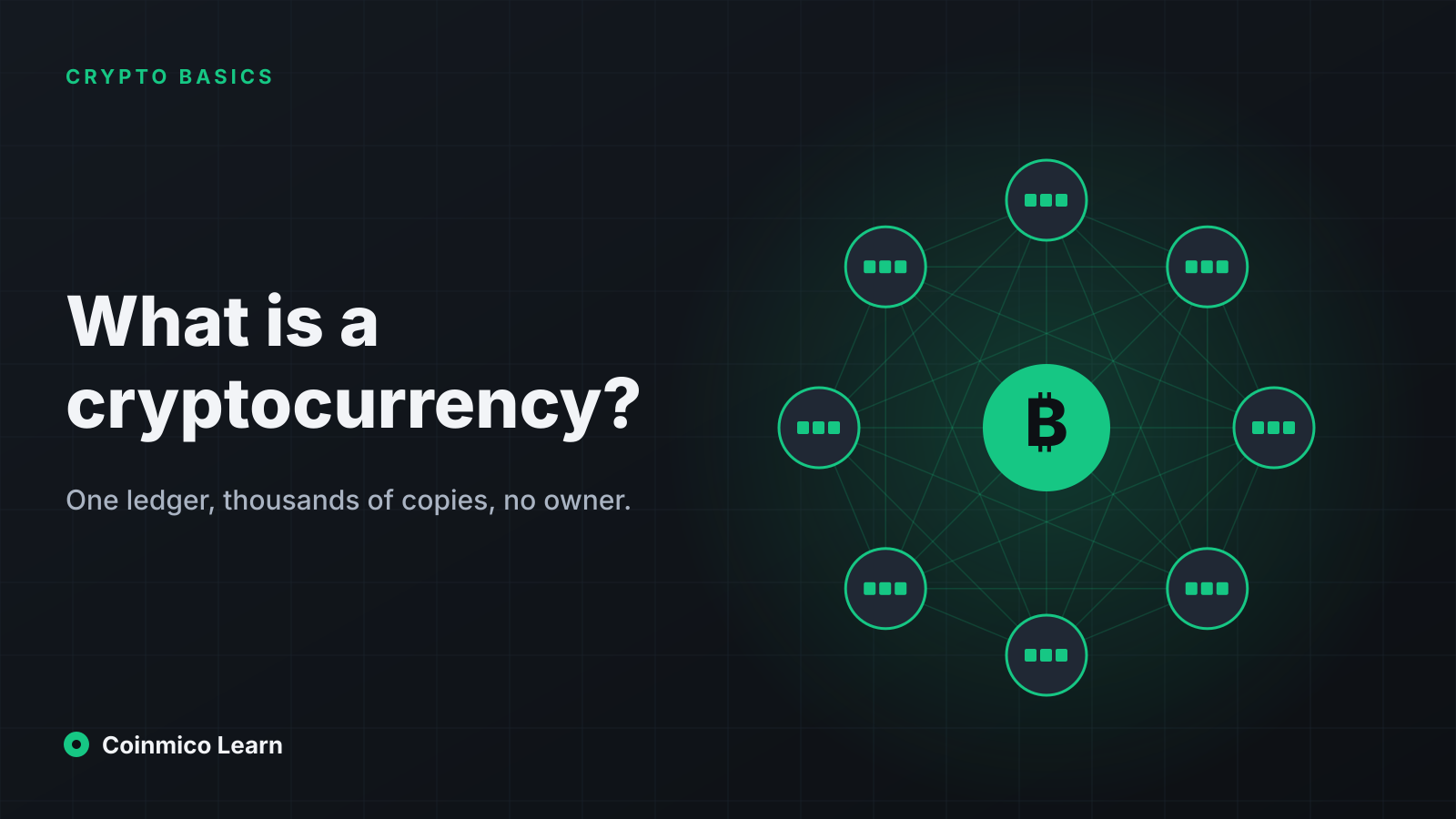
A blockchain is a ledger with one difference: thousands of computers around the world each hold a full, identical copy. When a new page of transactions is added, every copy adds the same page. If one copy disagrees with the others, it is simply ignored.
That is the whole trick. Nobody is trusted to keep the book honest, because everybody can check the book against everybody else's.
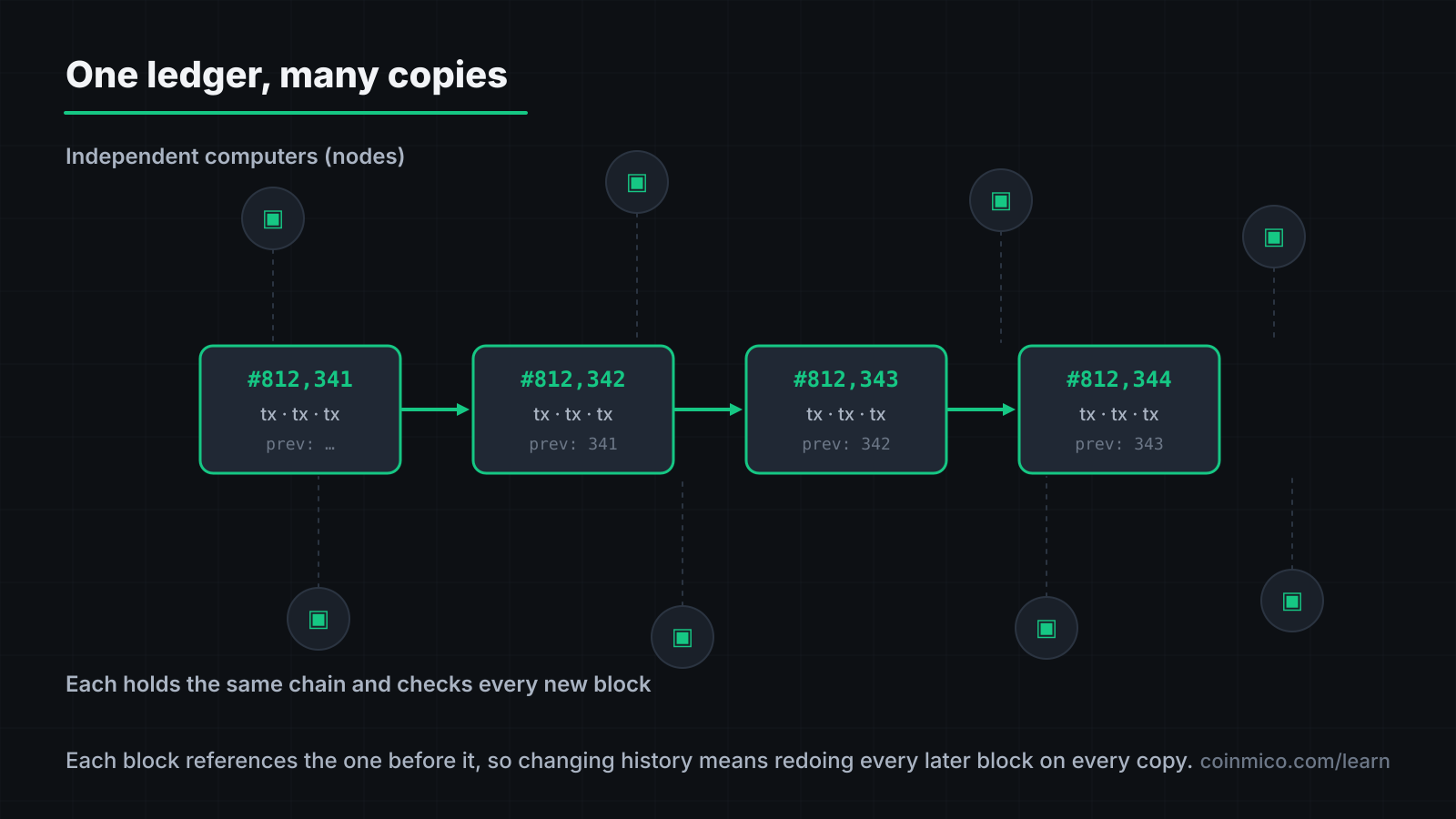
The pages are called blocks. Each block contains a batch of transactions plus a fingerprint of the block before it, which is why the structure is called a chain. Changing an old block would change its fingerprint, which would break every block after it — and every other copy would notice immediately.
Rules for changing the ledger
A shared copy is not enough on its own. Someone has to decide which transactions go into the next block, and in what order. Cryptocurrencies solve this with a consensus rule: a procedure every computer follows to agree on the next block without a referee.
The two rules you will meet most often:
- Proof of work (Bitcoin, Litecoin, Monero). Computers race to solve a costly puzzle; the winner proposes the next block and earns newly created coins. Rewriting history would mean redoing all that work, which is what makes the ledger expensive to tamper with.
- Proof of stake (Ethereum, Solana, Cardano and most newer networks). Participants lock up coins as a deposit. They are chosen to propose blocks in proportion to that deposit, and lose it if they cheat.
Both achieve the same goal by different means: make dishonesty more expensive than honesty.
The coin is what the ledger counts
With a ledger and a rule for updating it, you have a network. The coin is the unit that the ledger tracks. On Bitcoin's ledger the unit is bitcoin (BTC); on Ethereum's it is ether (ETH).
The coin does two jobs at once:
- It is the thing being transferred. When you "send bitcoin", the ledger reduces a number next to your address and increases one next to someone else's.
- It pays for the network's upkeep. Transaction fees and newly issued coins go to the people running the consensus rule, which is why they bother.
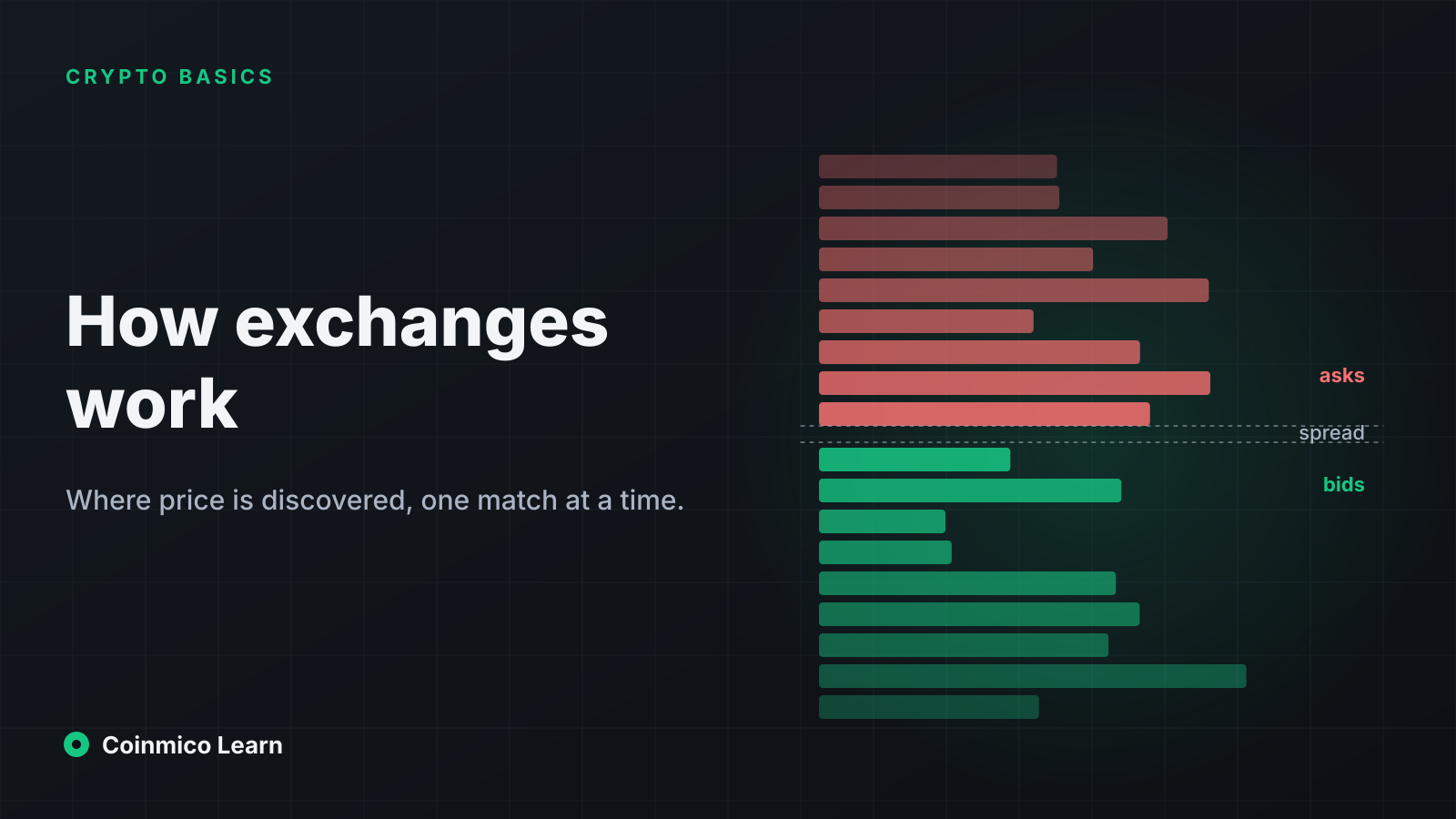
Nothing about the coin itself sets a price. The price is what the last buyer paid the last seller on an exchange — the same way a share price is set. Here is the figure Coinmico is measuring for bitcoin right now:
 BitcoinBTCAcross 50 spot markets we index
The number moves because buyers and sellers are trading on dozens of venues at once. Coinmico reads those trades directly and combines them; the methodology page explains exactly how.
Coins, tokens and networks
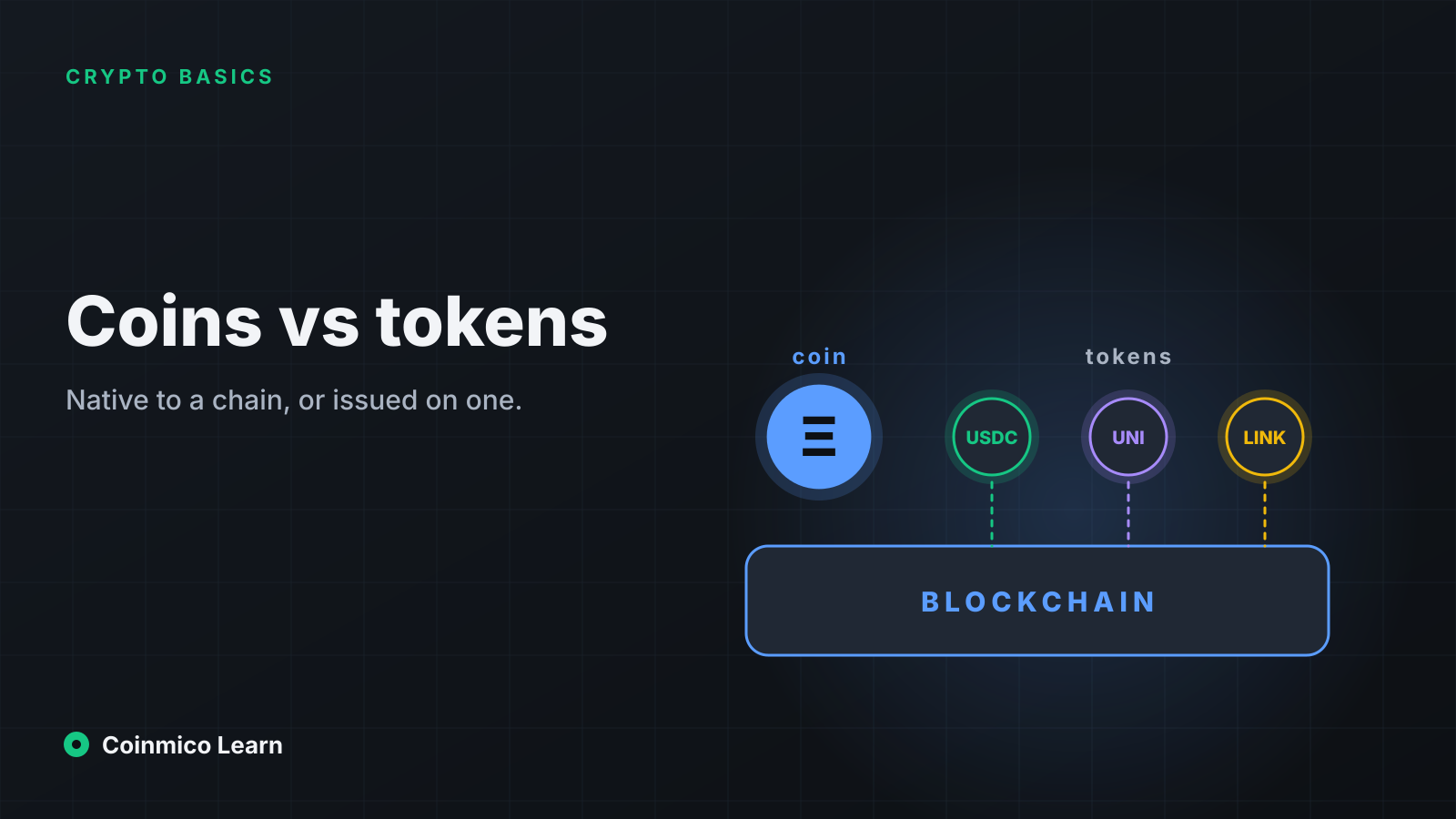
You will hear "coin" and "token" used interchangeably. The distinction matters, and the next lesson is devoted to it, but the short version:
- A coin is the native unit of its own blockchain (BTC on Bitcoin, ETH on Ethereum, SOL on Solana).
- A token is a unit created on top of an existing blockchain by a program. USDT and USDC are tokens on Ethereum, Solana and several other networks.
There are a few dozen networks that matter and tens of thousands of tokens. The [top of the market by market cap](/) is a mix of both.
| Coin | Price | 24h | 24h volume | Market cap |
|---|---|---|---|---|
| BitcoinBTC | $84,201.85 | 2.64% | $20.83B | $1.69T |
 EthereumETH EthereumETH | $2,661.09 | 3.25% | $9.37B | $324.8B |
 TetherUSDT TetherUSDT | $0.9998 | 0.03% | $1.20B | $183.4B |
 BNBBNB BNBBNB | $765.31 | 2.82% | $509.5M | $101.9B |
 XRPXRP XRPXRP | $1.49 | 5.63% | $3.86B | $93.63B |
 USDCUSDC USDCUSDC | $1.00 | 0.01% | $5.75B | $75.14B |
 SolanaSOL SolanaSOL | $114.15 | 3.37% | $2.61B | $67.07B |
 TRONTRX TRONTRX | $0.3391 | 0.79% | $206.1M | $32.20B |
 ZcashZEC ZcashZEC | $1,519.97 | 0.67% | $1.79B | $25.76B |
 Figure HelocFIGR_HELOC Figure HelocFIGR_HELOC | $1.03 | 1.21% | $170.4M | $23.71B |
Where "decentralised" comes in
Every cryptocurrency describes itself as decentralised. Treat that as a claim to be examined rather than a fact. The useful questions are:
- Who runs the copies? A network with thousands of independent copies is harder to shut down or censor than one with a dozen run by the same foundation.
- Who can change the rules? On Bitcoin, a rule change needs the overwhelming majority of the network to adopt it voluntarily. On some smaller networks a foundation can push an update.
- Who can freeze your balance? Native coins generally cannot be frozen. Many tokens can — USDT and USDC, for example, include a function that lets the issuer block an address.
None of these make a network good or bad. They describe what you are trusting when you hold it.
What this means in practice
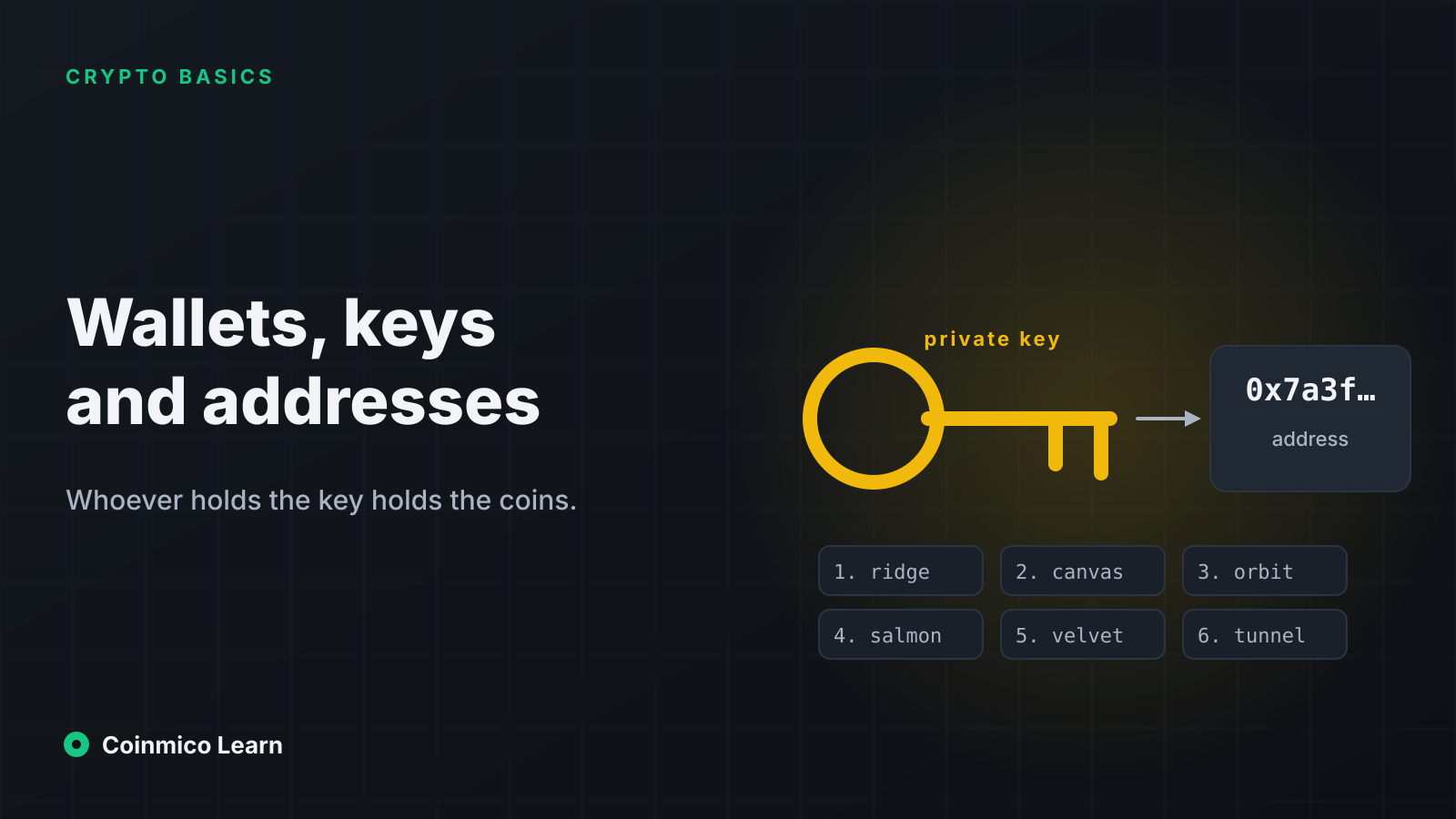
- Holding a cryptocurrency means controlling an entry on a shared ledger. Whoever holds the key to that entry controls the coins — which is why the lesson on wallets matters so much.
- The price you see is a summary of many trades on many exchanges, not a number set by the network.
- The market cap, volume and other figures on this site are measured from those trades. When a figure is estimated or borrowed from elsewhere, the page says so.
Next in this track
The next lesson unpacks the coin-versus-token distinction properly, including why the same token can exist on five networks at once and what that means for its price.
Assets in this piece
 Bitcoin
 Ethereum
Every figure here is measured by Coinmico across the venues and chains we index. See our methodology.