Seed phrases and self-custody: holding your own keys without losing them
Self-custody means no one can freeze your coins and no one can recover them for you. This lesson covers what a seed phrase actually is, how to back it up so it survives fire and forgetting, and the choices that decide whether self-custody is safer than an exchange for you.
What you will learn
- A seed phrase is a human-readable encoding of a master key. Every wallet derived from it is recoverable from those words alone, on any compatible software.
- The phrase must survive two opposite threats: loss (fire, water, forgetting where it is) and theft (photos, cloud backups, anyone who reads it). Paper in one place fails the first; a screenshot fails the second.
- A hardware wallet keeps the key off your computer. It does not protect against signing a malicious transaction, which the final lesson covers.
The wallets lesson established that whoever holds a private key controls the coins, and that a seed phrase is the backup of every key a wallet will ever generate. This lesson is about the practical consequences: how to store those words so that you can always recover them and nobody else ever can.
What the words are
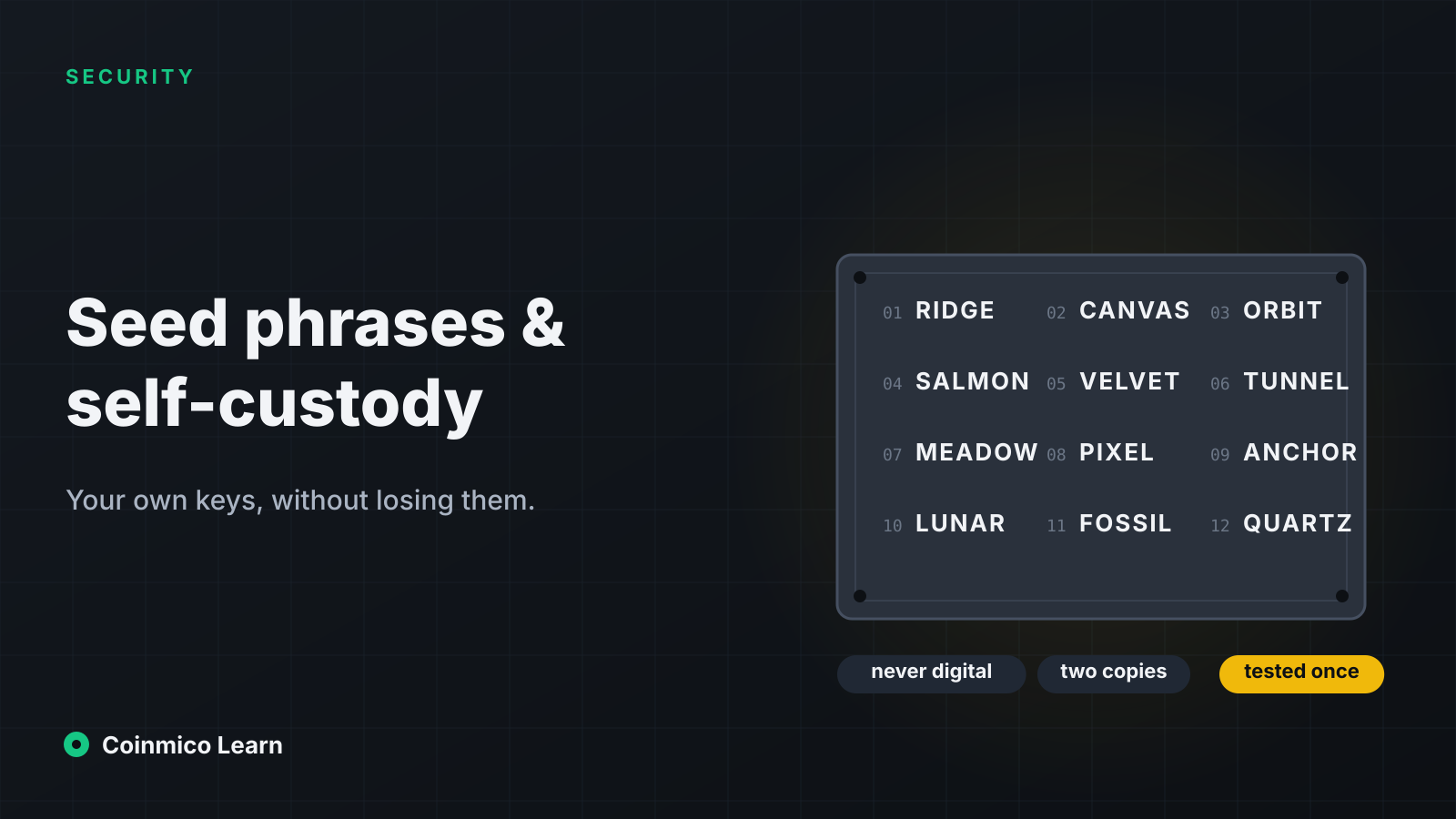
A seed phrase — 12 or 24 words from a fixed list of 2,048 — is a 128- or 256-bit random number written so that a human can copy it without error. The wallet turns it, through a standard derivation, into a master key, and from that into every account and address you will use. The standard is shared, so a phrase generated in one wallet app recovers the same accounts in any other.
Three consequences:
- The phrase is the wallet. The app, the device and the password are conveniences. Anyone with the words has everything; anyone without them, including you, has nothing once the device is gone.
- The words are never needed for normal use. A wallet asks for them exactly once — at setup or restore. Any website, app, "support agent" or pop-up asking for them at any other time is stealing them.
- A passphrase (the "25th word") is an optional extra secret that produces a completely different set of accounts from the same phrase. It protects against someone finding the words, at the cost of one more thing that must not be lost.
The two threats
A backup has to survive opposite failure modes at the same time.
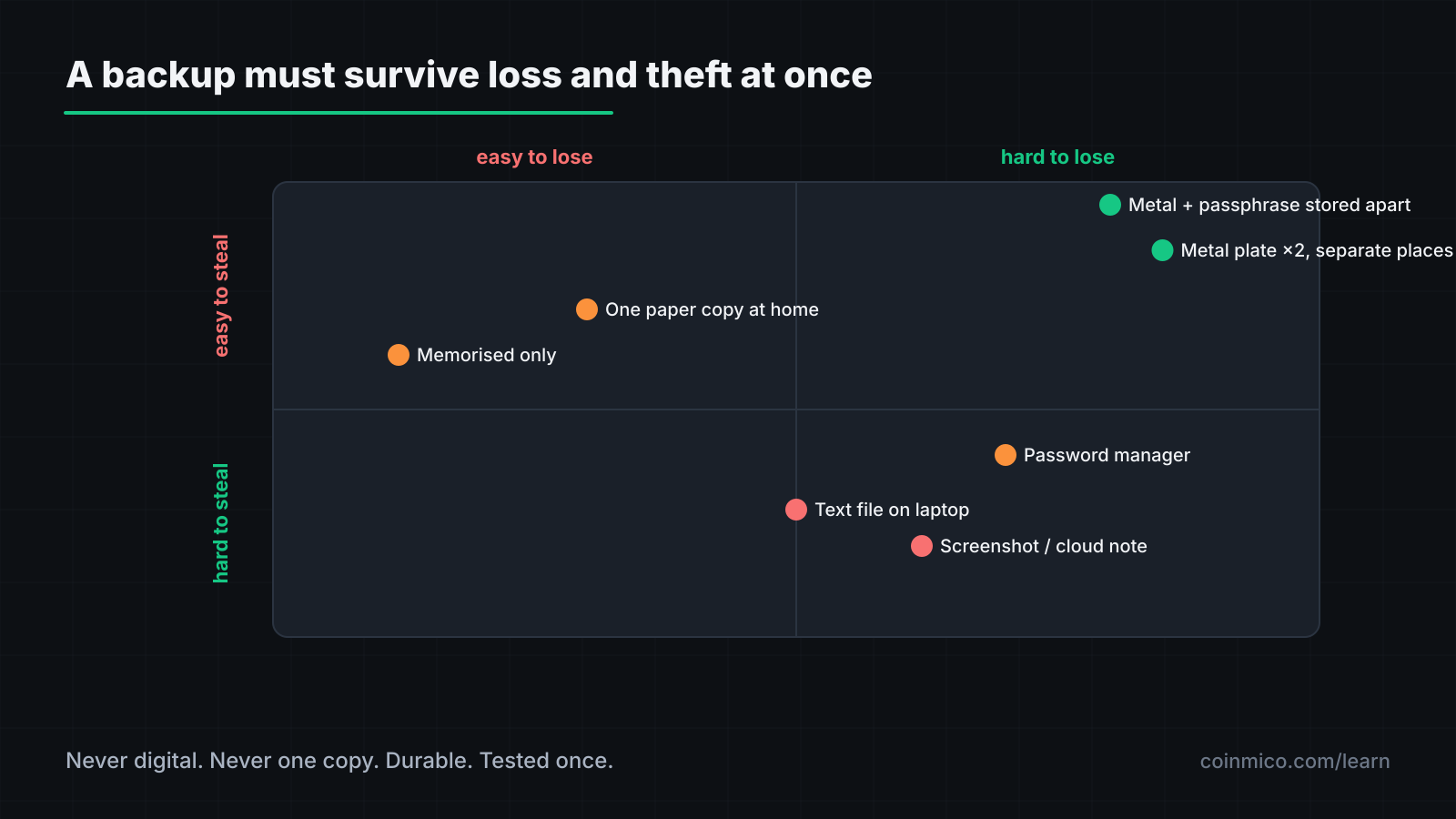
Loss. Paper burns, fades and gets thrown out in a move. A single copy in a single place has a real chance of not existing in ten years. Memory is worse: people forget words, transpose them, or die.
Theft. Anything digital is copied. A photo syncs to a cloud account that is phished a year later. A note in a password manager is exposed by a breach of the password manager. A text file is read by malware that searches specifically for twelve-word patterns.
The rules that follow from this:
- Never digital. No photo, no screenshot, no cloud note, no email to yourself, no typed file. The phrase should exist only on physical objects.
- Never one copy. Two or three physical copies in separate locations, so that no single fire, flood or burglary takes them all.
- Durable. Paper is the minimum; stamped or etched metal survives what paper does not. Metal backup plates are inexpensive and the standard for anything you would mind losing.
- Complete and verified. Write all the words, in order, and then actually restore a wallet from the backup once to prove it works. A backup that has never been tested is a hope.
Splitting and sharing
Keeping the whole phrase in three places triples the theft surface. Two approaches limit it:
- Passphrase separation. Store the 24 words in one set of places and the passphrase in another. Neither alone recovers the funds.
- Threshold schemes. Some wallets support splitting a secret into, say, five shares of which any three recover it (Shamir backup). More robust; also more complex, and only worth it for larger holdings.
Do not invent a scheme — writing half the words in each of two places means anyone with one half has a solvable puzzle. Use the standard ones.
Hardware wallets
A hardware wallet is a small device that generates and stores the key inside a secure chip and signs transactions without the key ever leaving it. Your computer prepares the transaction, the device displays what it is about to sign, you confirm on the device, and only the signature comes back.
What it protects against: malware on your computer reading your key. That is the most common way self-custodied funds are stolen, and a hardware wallet closes it entirely.
What it does not protect against: you approving a bad transaction. If a malicious site asks you to sign a transfer of everything you own and you press confirm on the device, the device does exactly that. The approvals lesson is about this gap.
Buy directly from the manufacturer. A device bought second-hand or from a marketplace reseller may arrive with a pre-generated phrase in the box — which means the seller has it too.
Self-custody or an exchange?
Neither is right for everyone. Be honest about which failure is more likely for you.
| Self-custody | Exchange custody | |
|---|---|---|
| Who can freeze or lose your funds | Only you | The exchange (insolvency, hack, account lock) |
| Who can recover if you forget | No one | The exchange, via identity verification |
| Main threat | Losing the phrase; signing a malicious transaction | Exchange failure; account takeover via your email/phone |
| Effort | Setup, backups, care with every signature | Password, 2FA |
A reasonable arrangement for most people: long-term holdings in self-custody with a hardware wallet and a metal backup; a working balance on a reputable exchange with strong 2FA for trading. The next lesson covers making that exchange account hard to take over.
 BitcoinBTCAcross 50 spot markets we index
What this means in practice
- Write the phrase on metal, twice, in two places, and test the restore once.
- The words are entered exactly once in a wallet's life. Every other request for them is theft.
- A hardware wallet protects the key. It does not protect you from what you sign.
Next in this track
Most people keep some funds on an exchange, and exchange accounts are attacked constantly — usually through the email and phone number attached to them. The next lesson shows how to close those routes.
Assets in this piece
 Bitcoin
Every figure here is measured by Coinmico across the venues and chains we index. See our methodology.