Order types explained: market, limit, stop and the ones in between
Every trade begins with a choice of order type, and the choice decides whether you pay for speed or for price. This lesson covers the four you need, what each one does inside the order book, and the mistakes each one invites.
What you will learn
- A market order takes whatever price is available now; a limit order names a price and waits. You trade certainty of execution against certainty of price.
- Stop orders trigger only when the market reaches a level. A stop-market can fill far from the trigger in a fast market; a stop-limit can fail to fill at all.
- On thin markets a market order moves the price against you. Check depth and volume before using one.
An exchange offers half a dozen order types with names that sound technical and mean simple things. Underneath, they are all instructions to the matching engine described in the exchanges lesson: at what price am I willing to trade, and when should the instruction become active?
The order book, briefly
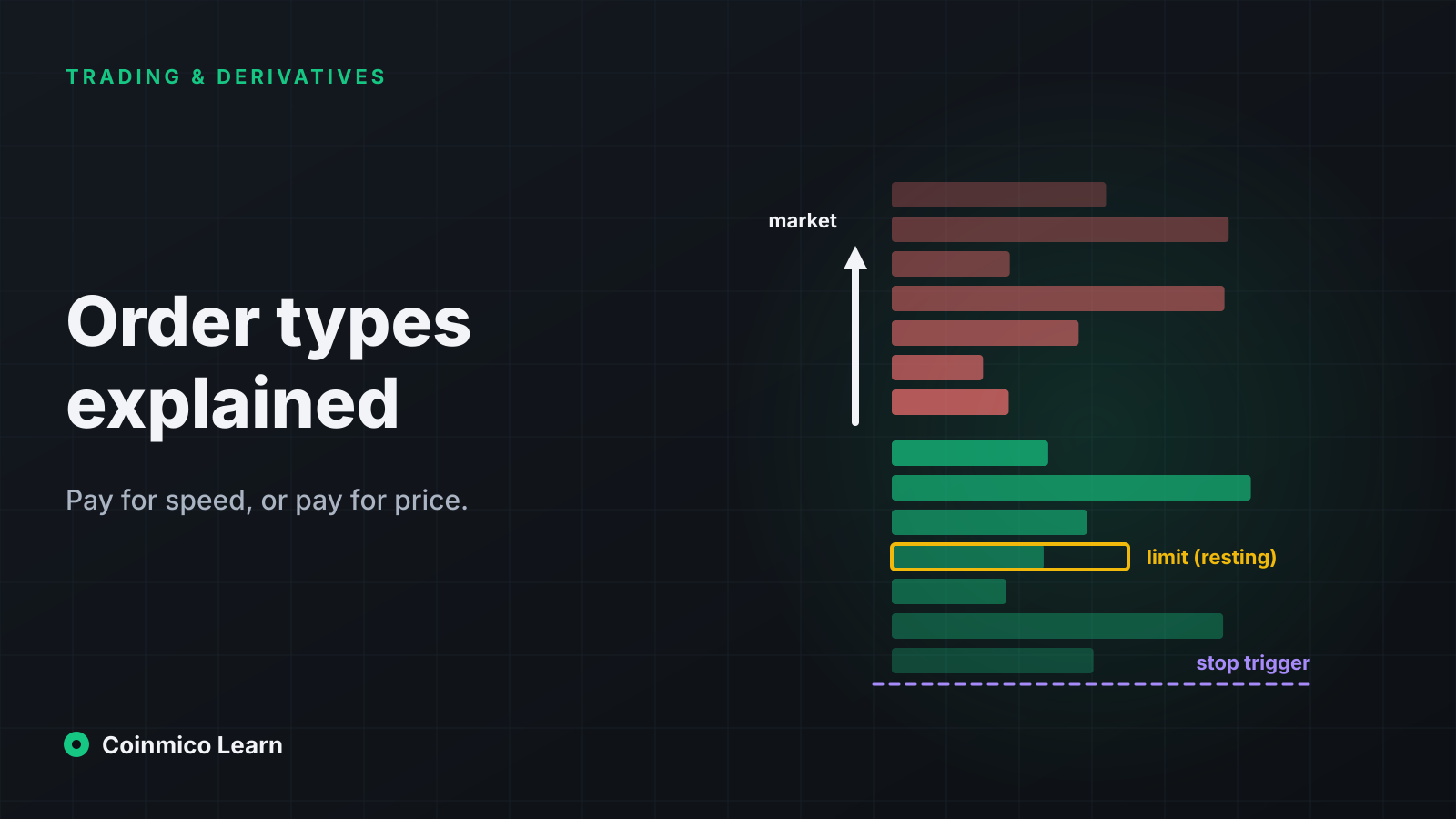
Recall that an order book is two stacks: bids (buy orders, highest at the top) and asks (sell orders, lowest at the bottom), separated by the spread. An order that can be matched immediately against the other side is aggressive and executes. An order that cannot is passive and rests in the book until it can.
Market order
Buy or sell now, at whatever price the book offers.
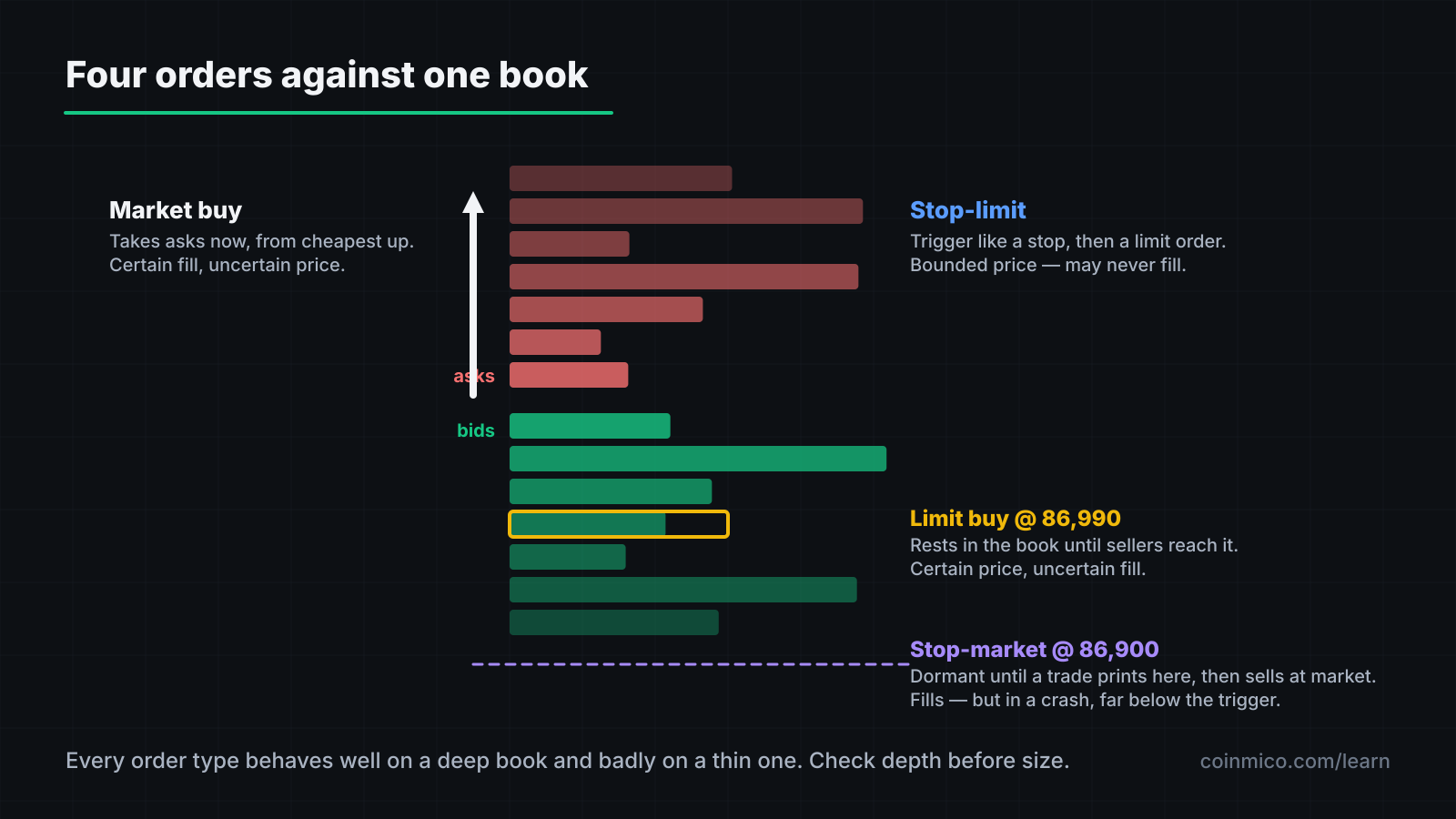
A market buy walks up the ask side, taking the cheapest asks first, until the whole size is filled. On a deep book — bitcoin on a major exchange — a modest order fills entirely at the best ask. On a thin book the same order climbs several levels and the average price is worse than the one you saw when you clicked.
The difference between the expected price and the achieved price is slippage. It is the cost of certainty: a market order always fills, but you do not know the price until it has.
Use it when speed matters more than a few basis points, and the market is deep relative to your size. Avoid it on low-volume pairs and in the seconds after news, when the book is thin and spreads are wide.
Limit order
Buy or sell at this price or better, and wait if necessary.
A limit buy at 87,000 when the best ask is 87,050 rests in the book as a bid. It fills only if sellers come down to meet it. You control the price completely; what you give up is certainty of execution. If the market never returns to your level, you never trade.
Limit orders also earn the lower maker fee on most exchanges, because resting orders provide liquidity for others to trade against.
A limit order placed across the spread — a buy at 87,100 when the ask is 87,050 — fills immediately at 87,050, the better price. It behaves like a market order with a ceiling, which makes it a safer default than a true market order on anything but the deepest pairs.
Use it as the default for entries and for taking profit. Watch for partial fills — a large limit order may fill in pieces over time, and the unfilled remainder stays live until cancelled.
Stop-market order (stop-loss)
When the price reaches a trigger, send a market order.
A stop sell at 85,000 does nothing until a trade prints at or below 85,000. Then it becomes a market sell and fills at whatever the book offers. This is the standard stop-loss: a way to exit automatically if a position goes wrong.
The weakness is in the second half. In a fast fall, the trigger prints and the book beneath it is already empty — the order fills at 84,200, or 83,000. Stops on thin pairs, or clustered at obvious round numbers, are where liquidation cascades and stop hunts begin. The liquidations lesson shows how that mechanism works.
Stop-limit order
When the price reaches a trigger, send a limit order at this price.
The trigger works as above, but the resulting order is a limit, so it cannot fill worse than the limit price. A stop-limit sell with trigger 85,000 and limit 84,800 will not sell below 84,800.
The trade-off is exact: you are protected from a terrible fill, and exposed to no fill at all. If the market gaps through 84,800 and keeps falling, the order rests unfilled while the loss grows. Stop-limits suit orderly markets and sizes small enough to fill within the limit band; a hard stop-loss suits the case where getting out matters more than the price.
Others you will meet
- Take-profit. A stop order in the profitable direction — trigger above the entry for a long. Same mechanics, opposite intent.
- Trailing stop. A stop whose trigger follows the price at a fixed distance, locking in gains as a trend extends. Set the distance relative to the pair's volatility, not as a fixed number; 1% is loose on a stablecoin pair and tight on a small cap.
- OCO (one-cancels-the-other). A take-profit and a stop-loss placed together; when one fills, the other is cancelled.
- Post-only. A limit order that is rejected rather than filled if it would cross the spread — guarantees the maker fee.
- Reduce-only. On derivatives, an order that can only shrink an existing position, never open or flip one.
Choosing, in one table
| You want | Use | You accept |
|---|---|---|
| To trade now | Market (or a limit across the spread) | Slippage on thin books |
| A specific price | Limit | It may never fill |
| Automatic exit, guaranteed | Stop-market | A bad fill in a crash |
| Automatic exit, bounded price | Stop-limit | It may not fill at all |
Depth decides everything
Every order type behaves well on a deep book and badly on a thin one. Before placing any order of size, look at the pair's volume and where it trades. A coin whose volume is spread across many venues has depth to absorb you; one whose volume is concentrated on a single small exchange does not.
| Coin | Price | 24h | 24h volume | Market cap |
|---|---|---|---|---|
 BitcoinBTC BitcoinBTC | $84,180.23 | 2.68% | $20.91B | $1.69T |
 EthereumETH EthereumETH | $2,666.76 | 3.15% | $9.35B | $325.5B |
 USDCUSDC USDCUSDC | $1.00 | 0.00% | $5.58B | $75.14B |
 XRPXRP XRPXRP | $1.50 | 4.54% | $3.91B | $94.61B |
 SolanaSOL SolanaSOL | $114.48 | 3.03% | $2.62B | $67.27B |
 ZcashZEC ZcashZEC | $1,526.90 | 2.18% | $1.80B | $25.87B |
 NEAR ProtocolNEAR NEAR ProtocolNEAR | $4.36 | 2.22% | $1.47B | $5.69B |
 TetherUSDT TetherUSDT | $0.9999 | 0.02% | $1.19B | $183.5B |
What this means in practice
- Default to limit orders. Use a market order only when you have checked depth and decided speed is worth the cost.
- Place stops where the book is likely to be thick, not at the round number everyone else chose.
- On a small coin, your own order is part of the market. Size accordingly.
Next in this track
Spot orders trade the coin itself. The next lesson introduces the instrument that carries most of crypto's volume — the perpetual futures contract — and the leverage that makes it dangerous.
Assets in this piece
 Bitcoin
Every figure here is measured by Coinmico across the venues and chains we index. See our methodology.