Perpetual futures: the contract behind most of crypto's volume
More dollars change hands in perpetual futures than in the spot market they track. This lesson explains what a perp is, how it stays tied to the spot price without ever expiring, and why leverage makes it the market's main source of violence.
What you will learn
- A perpetual is a futures contract with no expiry. You never own the coin; you hold a position whose gains and losses settle in the margin you posted.
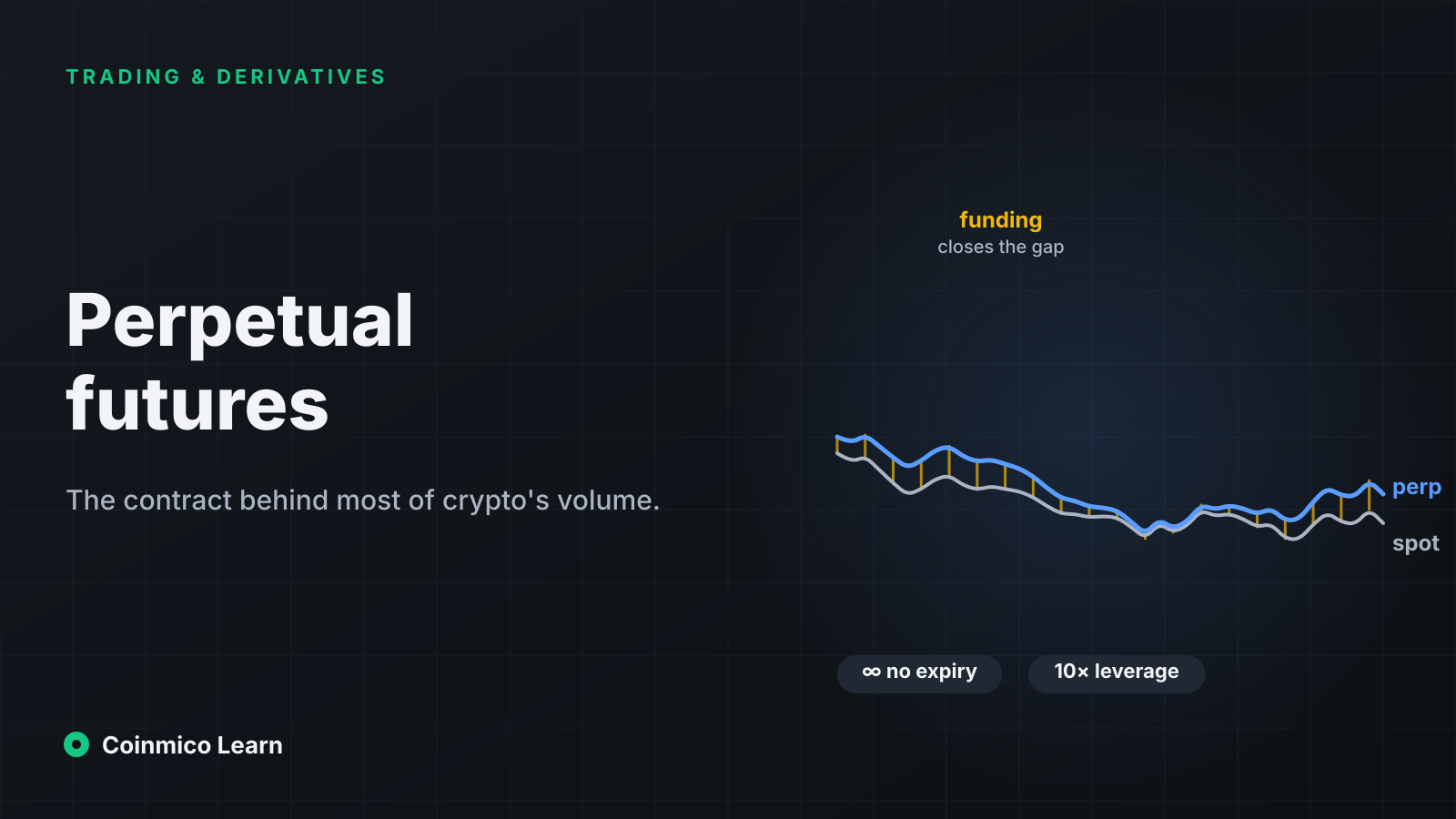
- The funding rate is what keeps a perp's price near spot — longs pay shorts when the perp trades above spot, and the reverse below it.
- Leverage multiplies both directions. At 10× a 10% move against you erases the whole margin, and the exchange closes the position for you.
Look at any large coin's markets and the derivatives volume dwarfs the spot volume. Nearly all of that is one instrument: the perpetual futures contract, or perp. Understanding it explains funding rates, open interest, liquidations and most of the sudden moves that seem to come from nowhere.
A futures contract, minus the expiry
A traditional futures contract is an agreement to buy or sell something at a set price on a set date. On that date the contract settles and disappears. Crypto exchanges took that idea and removed the date: a perpetual never settles. You open a position and hold it for a minute or a year, and its value tracks the spot price the entire time.
Nothing is delivered. You do not receive bitcoin when you go long a BTC perp. You hold a position whose profit or loss is calculated continuously against the price, and added to or subtracted from the margin — the collateral you deposited to open it.
Long, short, and the size of a position
- Long: you profit if the price rises.
- Short: you profit if the price falls.
A short is as easy to open as a long, which is one reason perps dominate: shorting spot requires borrowing the coin first, while shorting a perp is one click.
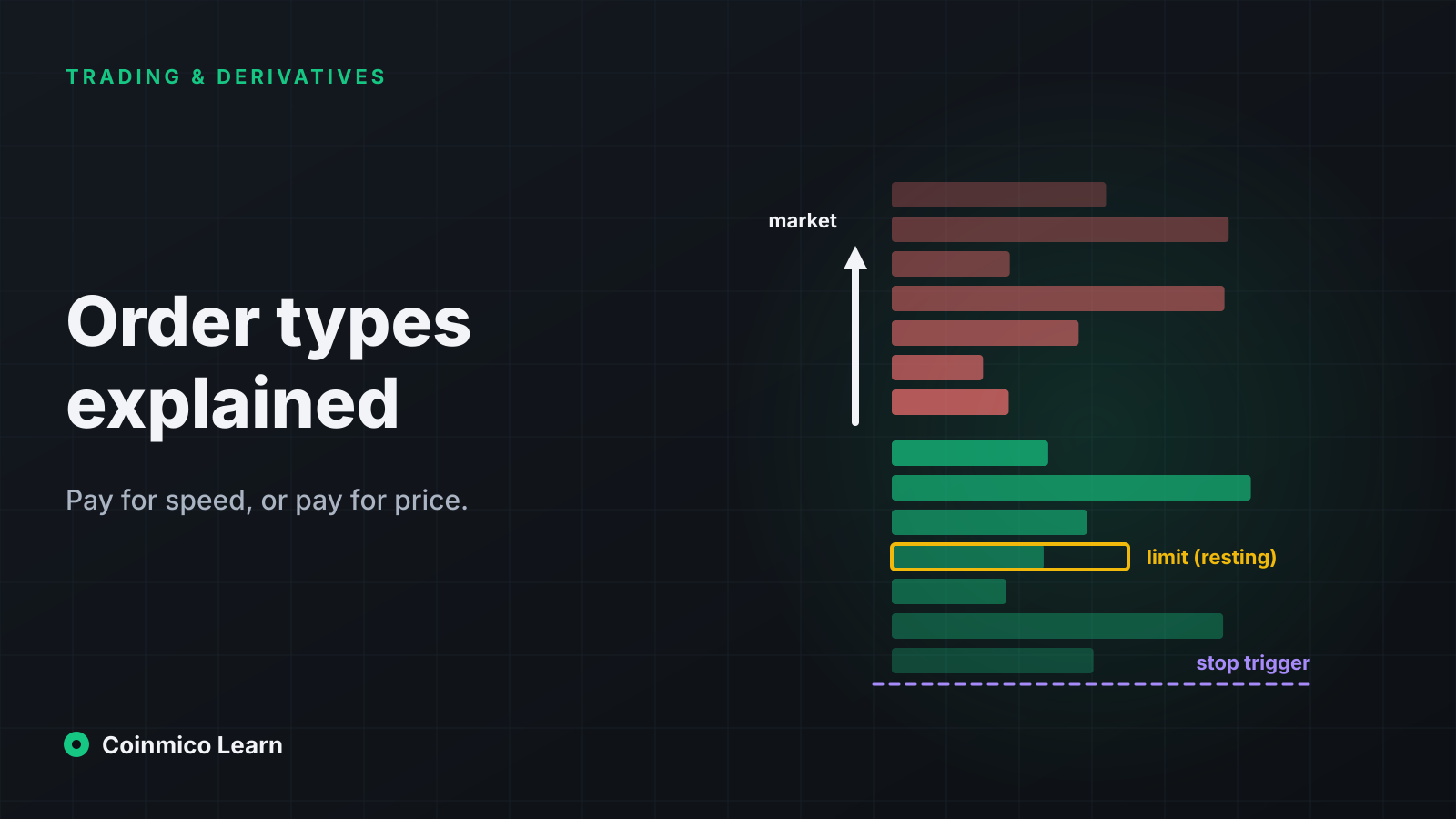
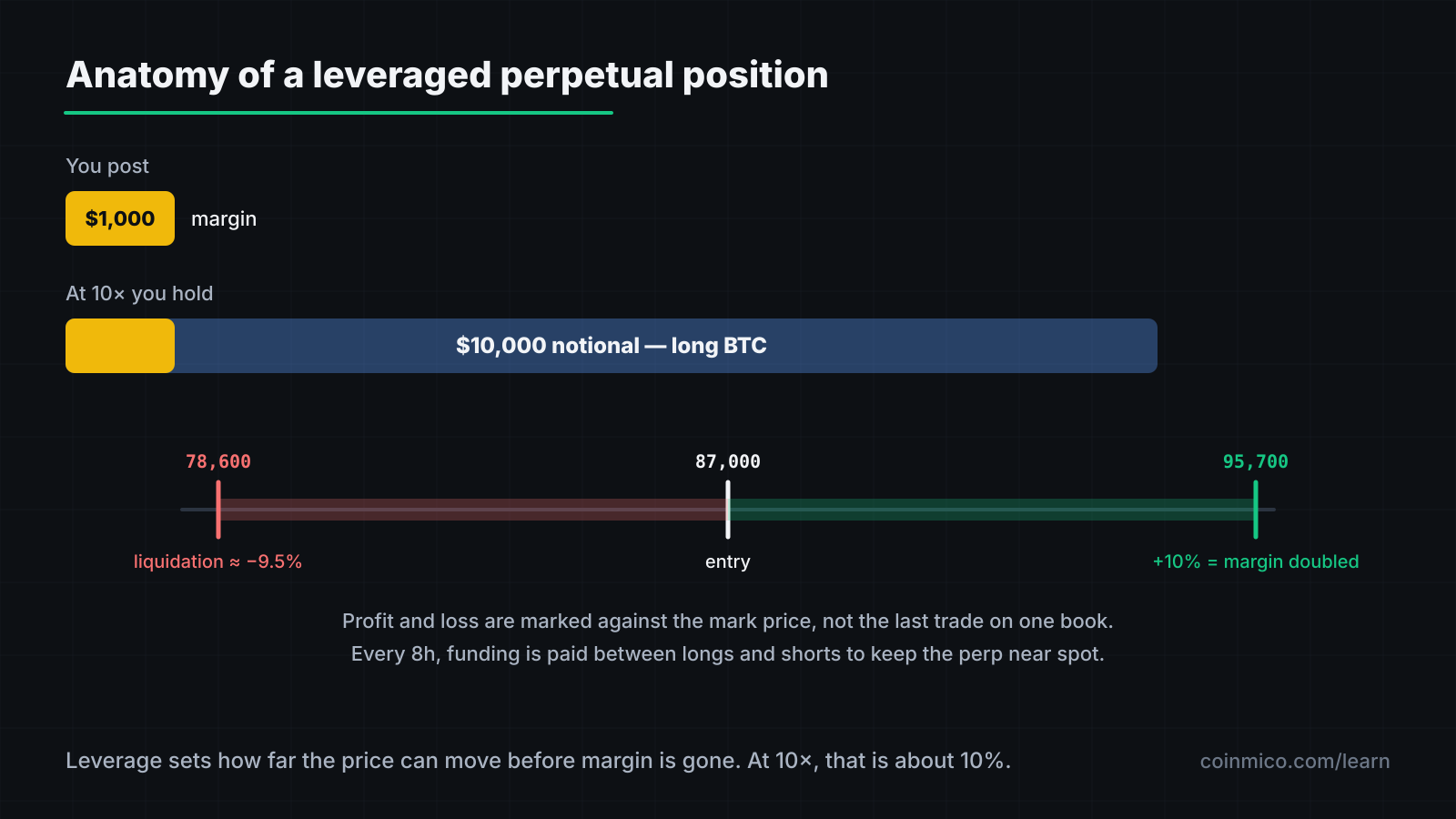
The size of the position is the notional — the dollar value of the coins it tracks. With 1,000 dollars of margin at 10× leverage you hold a 10,000-dollar notional position. A 1% move in the price is a 100-dollar change in the position, which is 10% of your margin.
Leverage and margin
Leverage is notional divided by margin. Exchanges offer up to 100× or more; the number that matters is how far the price can move before the margin is gone:
| Leverage | Move that wipes out the margin |
|---|---|
| 2× | 50% |
| 5× | 20% |
| 10× | 10% |
| 20× | 5% |
| 50× | 2% |
| 100× | 1% |
Bitcoin moves 2% in an hour routinely. At 50×, that hour is the whole account.
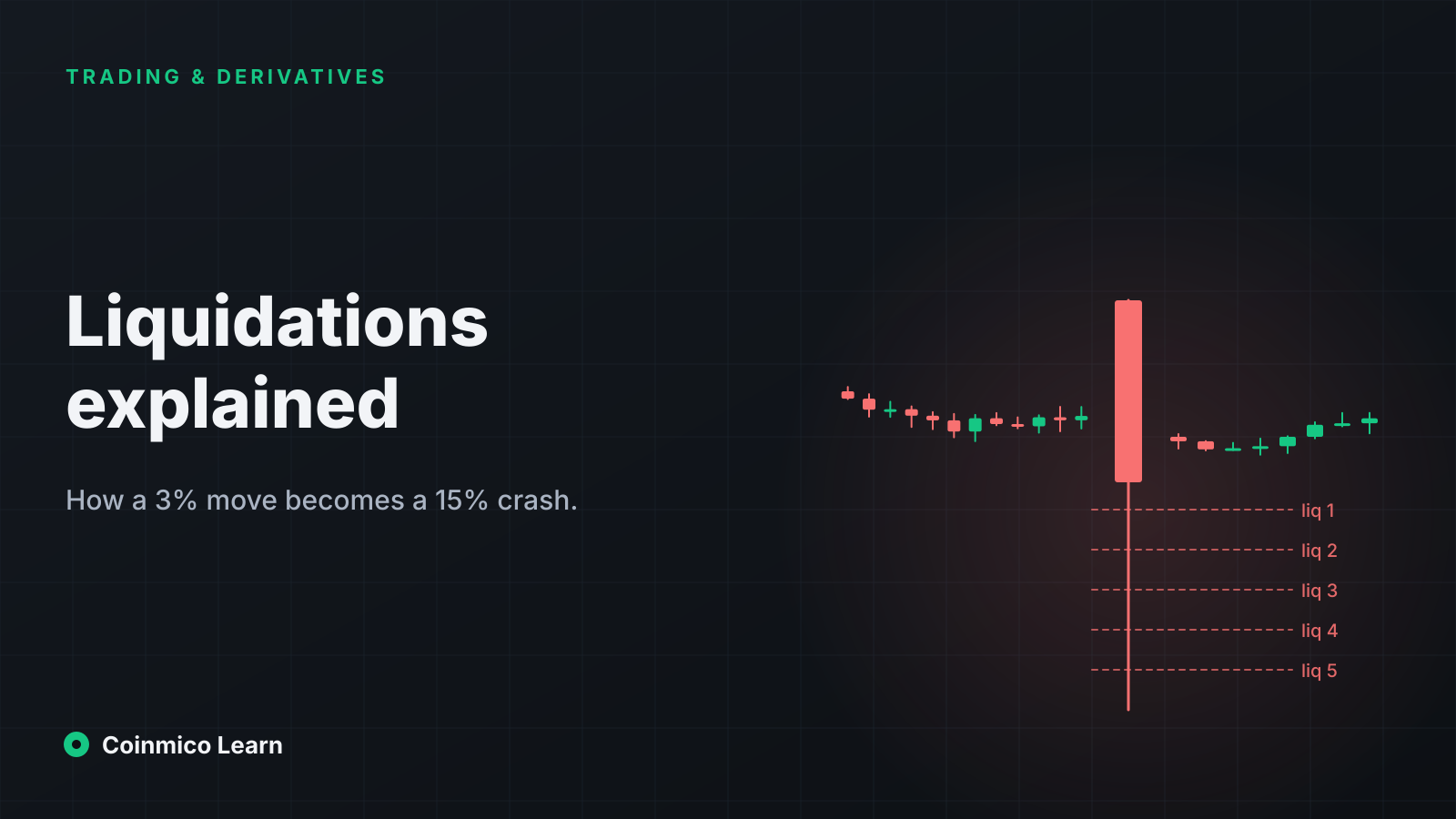
Before the margin reaches zero, the exchange steps in. When losses bring margin down to the maintenance margin level — typically 0.5% to 2% of notional — the position is liquidated: closed by force at market, with the remaining margin taken as a fee. The liquidations lesson covers what that does to the price.
The mark price
A perp's own last trade price can be pushed around briefly by a large order. If liquidations keyed off it, a single trade could wipe out thousands of positions. So exchanges calculate a mark price — usually the spot index price plus a smoothed version of the perp's premium over it — and use that for unrealised profit and liquidation checks. Your position is marked against the market, not against the last print on one book.
Funding: how the perp stays tied to spot
With no expiry there is no settlement date to force the perp's price back to spot. Instead, exchanges use a funding rate.
Every eight hours (on most venues; some use one hour), traders on one side pay traders on the other:
- If the perp has been trading above spot, longs pay shorts. Being long costs money, being short earns it, and the pressure pushes the perp back down towards spot.
- If the perp has been trading below spot, shorts pay longs.
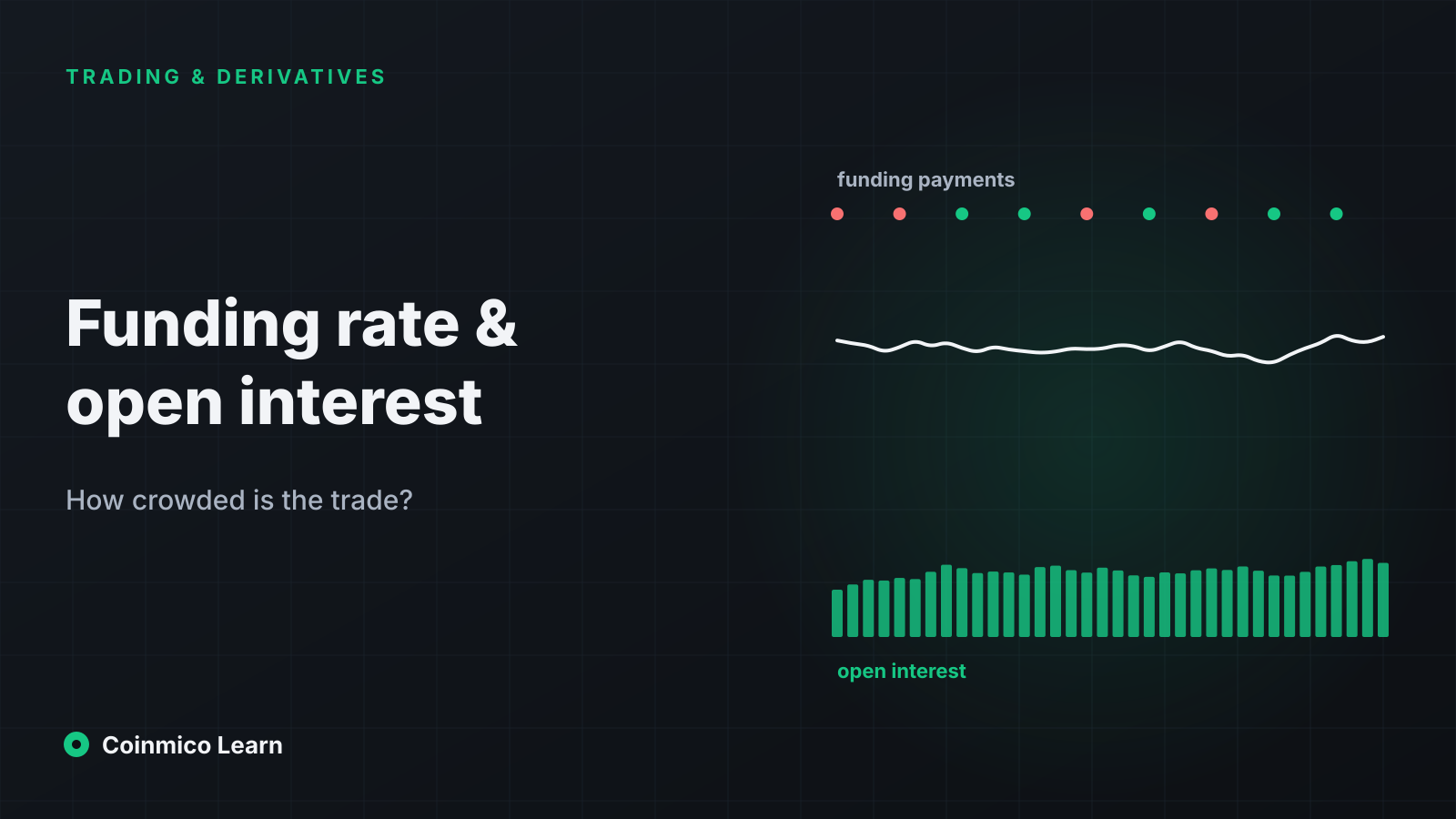
The payment is a percentage of position notional — a typical rate is 0.01% per eight hours, about 11% a year. In a frenzied market it can reach 0.1% or more per period, which at 10× leverage is a 1% charge on margin every eight hours just to hold the position. The next lesson explains how to read that as a signal.
Funding goes between traders, not to the exchange. The exchange charges trading fees on top.
Why perps carry so much volume
- Capital efficiency. Ten thousand dollars of exposure for one thousand of margin.
- Symmetry. Shorting is as easy as buying.
- No custody. No coins to withdraw, store or secure; the position is a number in an account.
- Liquidity. Because everyone uses them, the books are deep, which pulls in more use.
The cost of all this is that perps concentrate leverage, and leverage concentrates risk. When a large share of positions sit at similar liquidation levels, a modest spot move can cascade — each forced closure pushes the price into the next one.
Where Coinmico measures this
Coinmico records perpetual trades on the venues it covers and separates their volume from spot everywhere it reports. The derivatives exchanges page ranks venues by measured perp volume and open interest, and a coin's page shows its derivatives panel — funding, open interest and liquidations — whenever a perp market exists for it.
| Coin | Price | 24h | 24h volume | Market cap |
|---|---|---|---|---|
 BitcoinBTC BitcoinBTC | $84,068.97 | 2.83% | $21.02B | $1.69T |
 EthereumETH EthereumETH | $2,663.11 | 3.16% | $9.39B | $325.1B |
 USDCUSDC USDCUSDC | $1.00 | 0.02% | $5.61B | $75.14B |
 XRPXRP XRPXRP | $1.50 | 4.77% | $3.92B | $94.28B |
 SolanaSOL SolanaSOL | $114.28 | 3.04% | $2.63B | $67.15B |
 ZcashZEC ZcashZEC | $1,525.10 | 1.98% | $1.81B | $25.84B |
 NEAR ProtocolNEAR NEAR ProtocolNEAR | $4.35 | 1.99% | $1.48B | $5.69B |
 TetherUSDT TetherUSDT | $0.9998 | 0.03% | $1.19B | $183.4B |
What this means in practice
- Decide the leverage by the move you can survive, not by what the exchange allows. Below 5× the liquidation level is far enough away to think.
- Watch the mark price, not the last trade; that is what liquidates you.
- Funding is a running cost. A position held for weeks at high positive funding can lose more to funding than to price.
Next in this track
Funding and open interest are the two figures that tell you how crowded a perp market is. The next lesson shows how to read them together.
Assets in this piece
 Bitcoin
 Ethereum
Every figure here is measured by Coinmico across the venues and chains we index. See our methodology.